Tuesday, September 3, 2013

The Sith, the Jedi, the Ancient Force Religion, & the Two Great Struggles of Human History, Part 3

The ideas expressed as part of this blog are my own and in no way represent the beliefs of Star Wars creator, George Lucas. Any coinciding opinions as to the relationships between Communism, Nazism, and Star Wars are incidental for I do not claim to know Mr. Lucas' thoughts on these matters.

In our last meditation we discussed two supreme examples of the struggle between good and evil, liberty and tyranny, and the darkness they heaped upon the world in the mid part of the 20th Century.

We will now turn attention to the lessons that can be gleaned from the Communist-Nazi advance upon Planet Earth and what and how Star Wars can help us to think about the real world with respect to them.


The Calculus of Power: Great Ambition, Great Power, Great Deception, Great Destruction


Great Ambition


A villain of history possessed of great ambition
The above subtitle's calculus isn't meant for sport, but for analysis. Many times in Star Wars, as in other great morality and human condition tales, those possessed of awesome power, or the potential to gain such, are generally more tempted (not less) by its acquisition. The Jedi and Sith are the most poignant examples in the SW universe. And these examples are culminated in the rise and ultimate tragic fall of Anakin Skywalker, he who was to bring balance to the Force.
 
But we get ahead. Naturally, any amateur student of history recognizes the picture to the right - that of leader of Nazi Germany, the Fuhrer, Adolf Hitler. I do not exaggerate when I call him a villain of history, for Adolf Hitler's ambition and leadership cast Germany into a living hell of destruction and infamy on the world stage. He brought what was once considered the most civilized and advanced nation on the European continent to devastation and laid it low in reputation and honor.  
 
Why?
 
The explanation, I believe, begins with the German people's humiliation at the end of WWI, and the consummating promises of the Nazi party once it had risen to power. So, on a greater level, Hitler's rise was facilitated, not by his showmanship or grandiloquent oration alone, but by a fusion of the German people's desperation and fear, and Hitler's own unbridled belief in himself as their savior. This megalomaniacal ambition is the first of our calculus and here deserves the reader's thinking, for the Jainist says that great ambition - unchecked by principle and by truth - leads to a lust for unbridled power. And it is to power that we will turn our attention next.


Great Power


A villain of history invested with great power
I have no doubt that you also recognize the face to our left. Josef Vissarionovich Jugashvili, aka Josef Stalin, was absolute ruler of the former Soviet Union for almost thirty years. His death brought with it an end to decades of Red Terror (at least under his rule), poverty, and uncounted suffering. The power of this man went unchallenged in his time, and was only brought to an end when he died an ignominious death in March 1953. What brought this man to the leadership of the Russian people and its satellites so as to invest both he and the Union of Soviet Socialist Republics, which he cemented together, into being?
 
A host of factors can be examined - from Stalin's early "tutelage" under Vladimir Lenin and the Bolshevik "Reds," to his background work in the party then led by Lenin and Leon Trotsky, to ultimately his seizure of power at Lenin's death and Trotsky's forced exile and eventual assassination. However, though all of these factors played a role in Stalin's eventual rise to general secretary of the CCCP, what is of interest to us in our examination of the Calculus of Power, is Stalin's use of guile, cunning, deception, and maneuver to capture and remain in supreme power despite more than twenty years of failures as leader of the Russian people and the Soviet Union as a whole. From the Great Famines of 1932-1933 to the Great Purges of 1936-1939, the power of Josef Stalin to command the Soviet people was unparalleled. Using fear, intimidation, and murder, Stalin captured not only the obedience of Soviet citizens, but their hearts as well! This is no more poignantly demonstrated than when millions of Russian and Soviet citizens literally wept bitter tears upon the announcement of his death, an announcement that should have brought with it torrential waves of celebration and shouts of "Hoo-ray!"
 
Again, we see that it is not merely one man alone who takes his ambition and uses it to sow unto himself power of his own accord, but the social construct of those human beings around him, in both private company and public society, who invest within him their own desires, fears, and needs, then using the persona of his authority to gain for themselves the secret wishes of their hearts. Once this investment is made by such hungry, such needy, such desperate people, and once it is captured by the ambitious "Fuhrer," the ambitious "Leader," no amount of skulduggery, no amount of treachery is too low for such debased peoples to ignore.
 
Let us now return to our calculus within the fictional realm of Star Wars.


Great Deception 

 
"The goals of the grand plan [of the Sith] were
revenge and the reacquisition of galactic power."
 
 -- from the novel, "Darth Plagueis"
 
File:Countdookufullpromo.jpg
Count Dooku (Darth Tyranus), greatly deceived
The Serenno-born noble, Count Dooku, was once a revered knight of the Jedi Order. Strong in the Force, and hailed as one of the brotherhood's most noted lightsaber duelists second only to Yoda and Mace Windu themselves, he succumbed to the Dark Side after several fateful decisions by the Jedi Council left many of his fellow Jedi dead or themselves seduced by the Dark Side during the Clone Wars. Deceived by the influence of the concealed dark lord, Darth Sidious, Dooku left and betrayed the Jedi and the Galactic Republic further into the Clone Wars years through a series of political and military subterfuges designed by Chancellor Palpatine/Sidious to bring about the grand-ultimate plan of the Sith.

What is of interest to our discussion regarding Dooku is how his great affinity in the Force, and his great knowledge of both politics and power, were used by the wily Palpatine to trick him into his own demise and, ultimately, that of the Jedi and the Republic. Dooku's "beef" with the Jedi was the selling point used by Palpatine to lure the once-sterling knight into a web of, first, self-deception and pomposity, and, then, into a trap of mega-proportions which ensnared and then overthrew the Jedi Order and the entire Republic itself. Dooku was deceived, but not simply by Palpatine, but by his own arrogance - an arrogance that led him to believe that he, using the power of the Sith in the person of Palpatine, could transform first the Jedi and then the Republic into his own grand vision of order and justice. It was that arrogance, nurtured by Sidious, which led to the eventual destruction and death of the late Master Dooku.

The lesson to be gleaned from Dooku's fall is that deception - particularly self-deception concerning one's own perceived knowledge and insight - can be one's own worst enemy. The Biblical warning that, "Pride goes before a fall, and a haughty spirit before destruction," may be aptly applied to the late count. Further, we may also state that the idea of the ends justifying the means is a perverse and treacherous slope on which even the most learned and wise navigate at their own peril. Dooku learned this lesson in the most painful of ways.
 
And this leads us to the final variable in our Calculus of Power.


Great Destruction

Sith lord Darth Vader, greatly destroyed
In many ways, Anakin Skywalker, aka Darth Vader, is the sine qua non of our calculus, for it is he who embodied these qualities both separately and all at once. It is not necessary to tell the full tale of Darth Vader's rise, from his miraculous birth on Tatooine to his becoming a young Jedi padawan, forward into maturity, to his ultimate seduction by Palpatine and fall to the Dark Side.What is of note to us is how Anakin/Vader is, once again, used by the cunning Palpatine to accomplish the goals of the Sith. In a brilliant longterm strategy, Lord Sidious targeted a young and vulnerable Anakin, from early childhood through his very turbulent teen years and on into adulthood, for conversion to the Dark Side.

Throughout Episodes 1-3, we are introduced to an extremely powerful Force sensitive who will become known in Force prophecy as "the Chosen One." It is this lofty responsibility that Anakin Skywalker carries upon his shoulders for the rest of his life.

But life circumstances rend a canyon of conflict in the young Anakin - conflict that is seen by Palpatine early on. Unwillingly separated from his mother as boy, Anakin's loyalties and sense of duty are then always divided. Hot-tempered and impulsive, arrogant because of his abilities in the Force, the growing young Skywalker is not yoked in the ways of peace and serenity that so characterise the Jedi. And this is despite all efforts to train and root him in the Order's ancient precepts. It is these traits that Palpatine will use to tempt and then bring about Skywalker's fall as a grown man.

How?

By using a possible vision of the death of Anakin's secret spouse given to both himself and Anakin by the Force - Republic senator Padme Amidala.

Palpatine informs Anakin that only the power of the Dark Side can save Padme's life, that the Jedi are unwilling, and more, incapable of saving her. Only by joining his destiny as the Chosen One with Palpatine's as the master dark lord of the Sith can Anakin hope to preserve Padme from a premature death.

But once Palpatine is exposed to the Jedi as Darth Sidious, once his machinations for the galaxy are revealed, and the Jedi move to stop him, Anakin, in an act both of self-deceived hubris and desperation, protects Palpatine from destruction only to be told by the dark lord that he has no answers as to how to save Padme Amidala's life! This is the ultimate betrayal! for now, not only has Skywalker sworn fealty to Sidious, but he has, in the doing, murdered a Jedi master and become complicit in the destruction of the Jedi Order and the Republic.

In order, then, to seek the power he desires, Skywalker justifies his actions by going deeper into the morass that Palpatine has designed for him. He attacks the Jedi temple, massacring hundreds of Jedi, including children. He personally murders the leaders of the Trade Federation on Sidious' orders, paving the way for Sidious to take over the Republic - converting it into a starspanning Empire under his direct and supreme control. He attacks and fatally injures Padme Amidala, the very woman he loves and seeks to save. And, in the end, Skywalker, battles his former teacher and friend Obi-Wan Kenobi in a lightsaber fight to the death on the lava planet Mustafar.

Skywalker is hideously mutilated and scarred in the battle, defeated by Kenobi, yet left alive to suffer the fate which Skywalker had so haughtily prepared for himself.

Thus Darth Vader is born and slaved, of his own twisted lust for power, to the eternal service of Darth Sidious. And it is only by the struggles of his future son, Luke Skywalker, some thirty years later, that he is finally redeemed from this great fall.


Our Lessons?

What may we learn of the great struggles of history from this calculus within the Star Wars framework, and how may we apply them to the real world?

One lesson is that, as Lord Acton, once cleverly stated: "Power tends to corrupt, and absolute power corrupts absolutely."

Another is that power, in order to be as divested of abuse as possible, must be diffuse. That is, it must be divided into as many segments and spheres of authority as will appropriately permit its lawful and efficient performance. As the American Founding Father Thomas Jefferson recognized: "In questions of power let me hear no more of confidence in man, but bind him down from mischief by the chains of the Constitution." To expound upon Jefferson, and to add in Acton then: most power, invested in the personages of a few individuals tends to consolidate corruption. And yet, all power, invested in the person of one individual alone will most certainly bring about despotism and tyranny. To avoid this situation, a people must compose laws consistent with their history, culture, and tradition which limit and bind the ambitious from capturing and holding power with impunity.

Yet a third lesson is that evil, whatever its form, must be vigorously opposed in order for life, and light, to prosper. It must be stood up to with, in the words of the great song, "A British Tar," 'an energetic fist' that is 'ready to resist a dictatorial word.'

And in the case of the Communist-Nazi advance upon Planet Earth, as in the case of the Sith advance upon the Jedi and the Galactic Republic, we have the examples of good vs. evil and liberty vs. tyranny that finally had to be opposed and overthrown so that human dignity and destiny could be realized.

So that truth could be the victor.

There are, of course, more lessons. But I will leave those, dear reader, for you to meditate on, as I have.

As always, we at Epoc Enuma SF test the notions of speculative fiction against the real world in hope of aiding you to see how these "far away" ideas apply to the living, breathing universe we inhabit, and how, in fact, they are not so far away after all.


Until next time...


To the upward reach of man.


Tuesday, July 16, 2013

"Man of Steel": The Upward Reach Continues

Two weeks after its debut, I got the chance to see the 2013 incarnation of "truth, justice, and the American Way." Man of Steel (MoS), in my opinion, was an entertaining and thought-provoking movie on multiple levels. The bottom line analysis: it was good. I liked it.

Now let's look deeper and I'll tell you why.


Action? Or Violence?

I have very few gripes with this movie. My chief "negative" was the excessive mega-violence of the last 30 minutes or so when Superman confronts his Kryptonian fellows after they come to Earth and are hell-bent on terraforming it into a second version of their destroyed homeworld, Krypton.

Naturally, Superman moves to stop them. And this precipitates an orgy of train-throwing, skyscraper-falling, and heat vision shooting that leaves tens, possibly hundreds of thousands of defenseless humans dead in its wake. And though this level of destruction is shown in the film, its true impact is not really dealt with. In fact, I believe that impact is sacrificed for the sake of more and more action. I indeed believe that MoS  crossed the border from action into violence, and mega-violence at that. Something that, perhaps, is not necessarily befitting a Superman film.

I make this contrast because in Superman II, once our hero realizes that he cannot fight the murderous General Zod and his compatriots inside a major metropolis without sacrificing countless numbers of lives, he retreats from the city to the Fortress of Solitude to continue the fight there, thus removing a major tactical advantage from Zod's hands.

In fact, observe that from the opening moments of the conflict, Superman is already strategically calculating this in his mind. However, in MoS we are treated to a superfight of superfights, where beings of incredible, near god-like powers exercise those powers with absolute disregard for the mortals who are either crushed like cockroaches beneath their feet, or made to suffer horribly as collateral damage in the wake of their fiery battles for absolute supremacy.


This observation - and we shall not tarry on it much longer - is somewhat subjective, for indeed many other staples of SF/Fantasy depict just such carnage. And indeed the MoS version of Superman does attempt to limit, if not outright prevent, this level of mega-death. So I am not entirely judgmental of what was portrayed on screen. I do, however, believe it could  have been toned down just a bit, and greater emphasis given to other, more worthy areas of the movie. And I will go into some of these as we further the review.

I will not discuss in this meditation certain parallels to 9/11/01 and the global violence it has unleashed throughout the world, its impact on the planet as a whole, or the greater sense of foreboding and uncertainty it has left in the human psyche. Nor will I discuss how modern films are taking advantage of that moment in portrayal after portrayal on the big and small screens.

I believe most of us are intelligent enough to sort out the implications of that assault on our collective humanity for ourselves. And I believe the parallels in MoS are evident for most of us to see.


Dialogue for the "English Language Challenged?"

My second gripe was the under-whelming nature of the dialogue. At several instances I felt that the writers were attempting to pander to those who simply are too ill-read to appreciate high English, or what some might call "the King's English." While I realize that Superman is not Shakespeare, and that we are not being treated to...say a screen adaptation of The Lord of the Rings by comparison, I still believe that the composition of dialogue in a film should be equal to, if not surpass, not only the expectation(s) for the film, but that it should rise to the level of the film's outlook on human events.

MoS failed to accomplish this and I quite frankly felt that I was being fed a mouthful of dumbed down dribble at several key moments, moments that should have risen to a higher standard. A few examples follow.

* The dialogue between the high council on Krypton.
* The conversation between General Zod and Jor-El in the council chamber.
* The battle dialogue between Zod and Kal-El in the superfight over the city.
* The dialogue between hologram Jor-El and Zod on Earth.
* The family conversation between Jor-El and wife Lara before parting from baby Kal-El.

There are more examples I could give, but I'll limit them to those above, for I think all of these key scenes should have left the viewer with an emotional high, an impact that could be delivered by the dialogue along with, or even without visual assistance. Let's take a look at one quick example of how this was accomplished in Superman II.


Observe the power and majesty of these character interactions delivered by two superbly trained and experienced thespians. But more, observe how the might of the dialogue itself allows the actors to power punch this masterful, and very critical scene, into the viewers' minds.

Perhaps my criticism of MoS's dialogue is simply a throwback to my expectations for commanding presence as given in the Superman II performances of Terence Stamp and the late Marlon Brando. But your writer believes it to be more. In Hollywood today there seems to be a trend toward what some in the industry are euphemistically referring to as "natural acting," where the high drama of the Shakespearean style is being put aside for characters that are not "larger than life," but are instead perceived as closer to reality. They act and speak more real, more closely to the everyday, average person.

The Jainist questions this objective. Is this so-called "natural acting" what we go to the movie house to see? I think not, particularly with respect to science fiction and fantasy dramas. If this trend is true, then the Jainist says: CEASE AND DESIST before you forever reduce the brainpower of mass humanity to mental mush! High drama requires high dialogue.

Just as an example, The Lord of the Rings is still the standard for dialogue set by any group of modern SF/Fantasy movies I've seen in a long time. It rose to the level of the King's English and did not relinquish this standard for the sake of dumbing down its message so that the mere simpletons among us could understand it. It raised the bar and asked the audience to come up to that bar. It did not lower the bar so that we as the audience could feel good about our lack of ability to appreciate it. And this was a good thing. MoS should have given us a similar, but not necessarily equal emotional high. Unfortunately it left the Jainist flat at several critical instances.


"So What Did You Like?"


While the above criticisms may appear harsh, there was much to be excited about in MoS. First, I must give credit to the performances of the actors in this story. Even though I believe the dialogue weak at certain instances, and the focus of the story overcompensatory in the area of action and spectacle, I truly enjoyed the characters as a whole.

This is especially true of Kevin Costner and Diane Lane's Jonathan and Martha Kent. Supplementarily I also appreciated Antje Traue's Faora, and Henry Cavill as the centerpiece of the story, the Man of Steel himself. Indeed, while taking nothing as a whole away from any of the actors (who all performed well given the material), here I am simply pointing to those actors whose characters touched me most.

And in that rubric let's focus specifically on those whom I believe the real "heart" of the film - Jonathan and Martha Kent. While we are not treated to the same discovery of the "god-child" by the more aged couple seen in the 1978 Superman movie, we are given a similar emotional depth. And in the memories of the older and wandering Kal-El, we see the core of where his training in what it means to be human comes from. This is especially true of Jonathan Kent. Pa Kent teaches the young boy Kal-El (Clark Kent) that he is special, that he is the answer to humanity's long-standing hope to encounter other intelligent life in the universe, and most importantly, that he was sent to Earth for a reason. Papa Kent teaches the boy to hold his power with care, and that mastery of great power means, above all else, the ability to master one's self, and to restrain the impulse to abuse superior ability.

It is this discipline and restraint that Kal-El carries well into adulthood and manifests continually throughout the movie, even up to the point of the film's climax - the prevention of General Zod's world engine from terraforming an already living and populated planet, and most especially, in the killing of Zod himself.

Further, Jonathan Kent teaches his adopted son that he must hide his powers until the world is ready to accept him. This hard lesson is taken to its ultimate conclusion when, on the plains of Kansas, a tornado sweeps away Jonathan Kent's life. And though the young Kal-El possesses the power to save Papa Kent from the devastating storm, he honors Jonathan Kent's final request that he sacrifice his own father's life in order to fulfill that idea. The agony of this choice remains with Kal-El, and is one of the focal points of MoS.

Equally, Martha Kent is shown as the boy Clark's heart and anchor. It is she who teaches the child Kal-El/Clark to focus his ability, to see the greater scope of reality, not as a burden for the enlightened, but as a gift to understand the larger truths and scope of existence. This is showcased when a very young Kal-El realizes he has the ability to see through solid objects, such as human skin. He can see a heartbeat, blood pumping, he can perceive sounds inaudible to the human ear, and at farther distances. Martha Kent's instruction for her son: focus only on what you want or need to see, hear, know - to understand - at any particular moment in time. The brilliance, yet subtle love, of this simple lesson is a manifestation of the love of a mother for her child, and in the context of the story, of Martha Kent's deep understanding of the consequences of Kal-El's burgeoning powers.

Quite honestly, your writer loved these moments (and would rather have seen more of this than flying trains) because they demonstrated the humanity and positive upbringing we have all come to associate with Superman. They demonstrated that great power need not be abusive or predatory against those with lesser power. Indeed, greater power demands greater discipline and greater empathy for those who are weaker.


Further, these core lessons given by Jonathan and Martha Kent add validity to the notion that the 1937-38 version of Superman which we have today was clearly infused with Judeo-Christian values. And they add credence to the Biblical injunction of training "up a child in the way that he should go." The man Clark/Kal-El/Superman obviously did not depart from them.


"And What of the Other Characters You Liked?"

the megalomaniacal General Zod
Let's start with the main antagonist in MoS, General Zod himself. Michael Shannon's portrayal of the man trusted with the defense of Krypton in my opinion was a good, if not great one. Honestly I was somewhat underwhelmed by this Zod, but not because of the actor. As before, I believe the dialogue was not handled appropriately by the writers. That being said, I do believe Shannon brought further depth of motivation and personality to the character than was seen in Superman II with Terence Stamp. And this is chiefly because the writers took the time to focus more on motivation and character complexity than the more one-dimensional obsequious self-importance and quest for vengeance of S2's Zod. This, again, is a reflection, mainly, of writing, both of dialogue and of the character direction that does not show up in dialogue. Zod in MoS represents, to me, a completion of the Zod begun in Superman II. I liked him and regard him as a villain to be respected on screen.

the villainous villainess, Faora
And now to everyone's favorite MoS femme fatale, Faora. I regard Faora as a shadow, or extension of Zod. She is not only Zod's right hand, but his sharpened sword. She is what he cannot necessarily be under enlightened scrutiny - one who enjoys slaughter, death, and combat merely for their own sake. She is a ruthless, cold-hearted warrior who indeed believes that "a good death is its own reward." There is no remorse for the lives she takes other than, perhaps, the lack of efficiency, and maybe even the lack of sufficient slaughter in her acts of violence. She believes that morality is a weakness, and that strength comes with the total disregard for empathy, kindness, or concern for her enemies. I think this was effectively demonstrated when she tried (and failed) to punch Lois Lane's head off during her escape from the Kryptonian prison ship.

Antje Traue's portrayal of this sadistic female was spot on. And further, Faora's absolute dedication to victory, and to Zod, regardless of the consequences, and regardless of whether victory is attainable, made Traue's depiction of the character all the more satisfying. Callousness is unattractive enough in a man. And a woman who manifests such despicability is even more enjoyable from a dramatic sense. A++ to Antje for allowing me to feel utter disgust but utter enjoyment for her character's hatred of anything good and decent! And this is what a superb villain should do in drama-- present to us a contrast of an ideal good by showing its opposite and opposing characteristic in the form of an ideal bad. And I gotta say that in some ways Faora was a better image of this than Zod. But perhaps that too was deliberate on the part of the filmmakers, for as I said, she is an image or extension of Zod's will.


The Man of Steel Himself

Let us of course not overlook the Man of Steel himself. Henry Cavill impressed me with his portrayal of Superman with respect to the humanity and compassion of the character. This is most especially true when considering his dealings with the United States military and even in the confronting of his fellow Kryptonians themselves. We have already dealt with Superman's killing of General Zod in the final battle sequences. Let's deal then with Kal-El's confronting of humanity when he ultimately reveals himself in the face of Zod's threat.

It is obvious that Superman voluntarily and willingly surrendered himself to the authority of the U.S. government in the form of its defensive structures, and subsequently, and implicitly, to the scrutiny and subjugation of humanity as a whole. Naturally, while Superman was able to defy human authority at any time, unlike Zod and his minions, Kal-El deliberately wished to show himself a friend to the human species despite his superior ability and understanding of the universe as a whole. This is consistent with the Superman that has been portrayed for the last 75 years, and in such framework worked well in the movie.

We also cannot overlook the obvious Christ symbology inherent in Superman's appearance on Earth. In at least two critical scenes we are given this symbolism. The first is when young Clark agonizes over when and how to introduce himself to the world in the wake of Zod's threat to annihilate Earth if Kal-El does not surrender himself. Clark goes to a Catholic church and, with the image of Christ Jesus behind him, confesses to the resident priest that he is the one Zod and the U.S. government are looking for.

Let's bypass my disappointment with the lack of in-depth screen time this actually got - again, in my opinion, this is another moment where substance was substituted for engrossing but overcompensated for action - and focus instead on its meaning.

The second obvious Christ analogy is when Kal-El departs the Kryptonian prison ship after holographic father Jor-El tells him: "You can save her. You can save them all," referring of course to Lois Lane's emergency ejection from the prison ship inside an escape pod, and the human race's impending doom if Zod has his way at terraforming the planet into a new Krypton. Kal-El departs the ship into the vacuum of space, arms outstretched, his legs straight and together in a more than obvious crucifixion-cross pose.

The meaning of both these scenes is quite clear: Clark/Kal-El is a savior for mankind. And though he is not necessarily the ultimate one in the Christian sense, he is a figure, a shadow of the savior sent from Heaven to guide mankind and show them the way to preserve what they are, and what they are meant to be as a creation and expression of the Deity's will and power in the universe.

I also must given Henry Cavill credit for his portrayal of Superman, not as the more mature individual we are treated to in the Christopher Reeve incarnations, but as a Superman less comfortable and less knowledgeable of his power. In several scenes we observe a younger Man of Steel still in varying phases of discovery with respect to his superabilities. The flying scene is especially peculiar to this. Superman begins by realizing his ability to "leap tall buildings in a single bound" by indeed bounding over dozens, even hundreds of whole miles at a time until finally taking to the air in sustained flight that ultimately sees him crash headlong into a mountain - obliterating the mountain incidentally! - yet not being in full control of this astonishing capability to defy gravity! Then the Man of Steel takes full possession of this feat and soars into the very vacuum of space itself!

We'll not tackle the physics of how a man can endure the rigors of space without a suit or other supporting means, but leave that to the suspension of disbelief necessary to make the Man of Steel the man of steel.

Finally, he returns to Earth, flying at supersonic, even hypersonic velocities across land and sea! The pure excitement of these feats is spectacularly acted by Mr. Cavill, causing the viewer to share in the wonder of what it must be like, even in the storehouse of imagination, to realize such greatness. Indeed, as kids are want to do, it makes one want to put on one's red bedsheets, step out onto the front porch, and soar off into the sky!

There are other moments which punctuate Henry Cavill's Superman, such as his defense of his mother after Zod attacks her home, his first sustained uses of heat vision, and so forth that demonstrate the depth of the latest reincarnation of this iconic figure.

Yet suffice it to say, we are given a Superman who is indeed worthy of the character, not a boiled down, dumbed down one who merely demonstrates the ability to exert muscular fortitude, but one who proves that muscle alone does not win battles or hearts.

Yes, this version of the Man of Steel does justice to the Superman mythos. And it lives up to the Superman ideal that we at Epoc Enuma also share...


...the upward reach of humankind.


It is a "go see."


Grade: 3.5 of 4 stars.


Until next time...


To the upward reach of man.


Tuesday, April 30, 2013

The Sith, the Jedi, the Ancient Force Religion, & the Two Great Struggles of Human History, Part 2

We began this meditation discussing what I believe to be the two great struggles of human history and their manifestations in the fictional universe of Star Wars between the Force factions of the Sith and Jedi Orders. To reiterate, the two great struggles of human history are those between good and evil, and liberty and tyranny.

Now let us turn our attention to two real-world great struggles which I will use as examples of this understanding.

Two Great Struggles in History: Totalitarian Collectivism at its Worst

In the 20th Century humanity was confronted with two of the greatest forces for evil in the history of the earth. I refer to the movements known as National Socialism (Nazism) and International Monolithic Communism. In this section, the Jainist will show you, dear reader, in a brief and broad sense, how these two absolutist forms of collectivism are very much more similar than one may think. Further, as we continue, I will show you that the ideological foundations for both these totalitarian monsters were in fact the same.

So let's begin.


Nazism

Let us consider the actual, worldly Jew -- not the Sabbath Jew...but the everyday Jew. ... What is the worldly religion of the Jew? Huckstering. What is his worldly God? Money. Money is the jealous god of Israel, in face of which no other god may exist. Money degrades all the gods of man -- and turns them into commodities. The bill of exchange is the real god of the Jew. His god is only an illusory bill of exchange. The chimerical nationality of the Jew is the nationality of the merchant, of the man of money in general.

-- Karl Marx, "On the Jewish Question", 1844

One of the most misrepresented ideas is that Hitler and the Nazi regime started "the Jewish Question." This is farcical, as the above quote, given by modern ideological socialist founding father, Karl Marx shows. Note that his statement is 95 years before the outbreak of WWII.

It should be further understood that Adolf Hitler himself often declared that much of the doctrinal basis for Nazism originated with the ideological beliefs of Marx. Many are unaware of this truth. However, read this 1925 New York Times article in which future Nazi minister of propaganda Joseph Goebbels states his belief that the difference between the "Hitler faith" and that of communism is "very slight." Goebbels' statement is an eye-opening revelation within itself. But let's look deeper, for there may be further hidden truths to the notion that the difference between the "Hitler faith" and the communist faith is "very slight."

Many are also unaware that for at least a decade before the advent of World War II, Communist Russia was already practicing industrial-scale murder in the form of both outright murder and genocide vis-a-vis starvation. For example, during the years 1929-1934 more than 2.7 million people were starved to death by the genocidal polices of Josef Stalin. This figure does not count the 7 million - MILLION - who died in 1933 alone because of Stalin's practices of food confiscation from, and then isolation of, the Ukraine.

If one adds these figures altogether, a total of greater than 9.7 million human beings lost their lives to the deliberate Stalinist practice of the Ukrainian famine of 1929-1934.

Moreover, the evidence of wholesale murder in order to suppress ethnic peoples inside the Soviet Union, and to restructure Soviet-communist society worldwide, is indisputable.

Sickening, isn't it?

Yet, these works of murder and starvation were studied by the Nazis before they ever began to contemplate "the final solution" to "the Jewish Question" inside Germany.

Think about that.

Soviet Russia taught the German Nazis how to be a more efficient force for killing. Nazi Germany did not, entirely, invent these practices on their own. They learned from their elder brother, Soviet Russia!

Coincidence?


Not hardly.


Communism

A revolution is certainly the most authoritarian thing there is; it is an act whereby one part of the population imposes its will upon the other part by means of rifles, bayonets and cannon, all of which are highly authoritarian means. And the victorious party must maintain its rule by means of the terror which its arms inspire in the reactionaries. Would the Paris Commune have lasted more than a day if it had not used the authority of the armed people against the bourgeoisie? Cannot we, on the contrary, blame it for having made too little use of that authority?

-- Friedrich Engels, "Controversy with the Anarchists", 1873

To denigrate violence as something to be rejected, when we all know that in the end nothing can be achieved without violence!

-- Friedrich Engels to Wilhelm Blos, (Letter, February 21, 1874)

Comrades!... Hang...no fewer than one hundred known landlords, rich men, bloodsuckers ... Do it in such a fashion that for hundreds of kilometres around the people might see, tremble, know, shout: "they are strangling, and will strangle to death, the bloodsucking kulaks."

Yours, Lenin.

-- Lenin's "Hanging Order" regarding the kulak revolt in the Penza Gubernia, August, 1918 

  
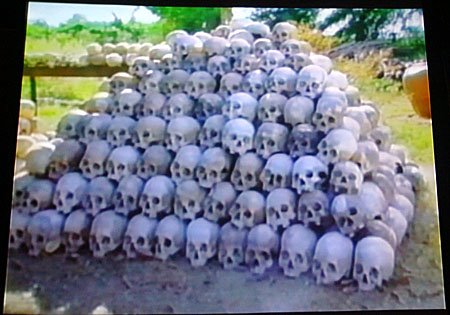
The red fist of Communism smashed down the lives of more than 100 million people worldwide. It left a bloodtrail of death from the Ukrainian famine/genocide of 1932-33 under Stalin to the Cambodian Khmer Rouge massacre of 1975. The theory of Communism has always been that once bourgeois capitalism has been overthrown, mankind could make way for the true and just governance of the proletariat and the classless basis of society. However, every time this "theory" has been practiced anywhere in the world, always the iron fist of dictatorship has followed. And such dictatorship has been loosed upon the world in the form of the unbridled murder and wholesale slaughter of innocents. There are those who say that what Lenin initiated in Russia in the early 20th Century, and what Stalin subsequently continued (and then exceeded by lightyear jumps) was not communism. That what these men did in terms of the murders of millions of people was an aberration - not in any sense of the word "communist." After all, Communism is about equality, peace, brotherhood - not murder.

The truth about Communism
However, the Jainist states emphatically that the bloodthirsty history of Communism, from its inception, is the actual fruit and reality of Communism! Indeed, dictatorship and murder, not equality, is Communism! That actual history, as stated before, can be seen in the slaughter of millions of human beings planetwide from Eastern Europe to Africa to Asia to Latin America. No Communist "theory" about "true" Marxism-Leninism substitutes for the reality of death pursued in the name of this so-called brotherhood movement.

But what is the basis for this pursuit in both Nazi and Communist philosophy? Why is killing an essential ingredient in the creation of the Nazi and Communist man?

The Nazi-Communist's "New Man": The Doctrinal Basis for Dictatorship & Killing

 ...there are times when the interests of the proletariat call for ruthless extermination of its enemies in open armed clashes.

-- V. I. Lenin (“Lessons of the Commune,” Collected Works, Vol. 13, p. 478)

The historical record is quite clear: once the Communist technique of subversion had run its course, and once the Communists had come to power in any country - it didn't matter where - they then proceeded to ruthlessly restructure the society by imprisoning, exiling, or outright murdering at least ten percent of the population. This included landowners, intellectuals, teachers, scientists, and especially those who resisted the Communist takeover, or, in particular, those who aided it to seize power in the first place.

One may ask, "Why? Aren't these some of the best people who would be needed to help rebuild the society and inoculate it against bourgeois ideas?"

A valid question.

But one which misses the more subtle point of Communist control. The point is to capture the minds of the target population by subjugating their will to the control of communism. The further point is to socially engineer the society so as to make it "more fit."

"More fit for what?" you ask.

Another valid question.

And here is the answer.


Ignore for a moment that this video focuses on Chinese communism. What I want you to get from this is Communism's assertion that it is the supposed answer to the ills of the world, and that its formula for the creation of a new society, a new kind of human being freed from the oppression of selfish individualism, is the correct model for the salvation of the world. And in the fuller context of the Communist "new man," we are to see from this video that it is society, as a whole, which has benefited from the enforced dictatorship of the proletariat. And because the people have not yet come to the realization that they must be lead to the paradise of egalitarianism, an enlightened few will act in the name of the greater masses of the people and lead them to paradise on earth, by force if necessary. For the greater good. This includes killing those who resist coming into alignment with the new reality imposed by the proletariat dictatorship, because, after all, they are too ignorant and set in the fallacies of the old ways to see the truth. They cannot be changed. And thus they must be eliminated, for their own good. And for the greater good.

But what is the Nazi counterpart to this idea?


While Communism preaches the notion of a new man based upon a false sociology, Nazism was equally interested in creating a new man based upon a false biology. We all have been taught to recognize the phony Nazi idea of the superior Aryan man, and thus the Jainist thinks there no need to quantitatively explain it to the majority of you. Suffice it to restate, however, Hitler's notion was that his "faith," as Goebbels put it, would create a new, superior form of life based upon the eradication of biologically inferior human beings. These humans expressed their biological inferiority culturally, intellectually, socially, even spiritually, by their inability to advance civilization, to defend themselves against "the stronger race(s)," and most significantly, by their inability to impose their way of life on the rest of the world. Planet Earth, therefore, belonged to the Aryan ubermensch and no one else.

Thus, in both Nazi and Communist philosophy we see the seeds of totalitarian control rooted in a false understanding of human nature. Both movements disagree with the human being as he or she is constituted. Both philosophies are at war with human nature as it is. And thus both ideas believe that if the enemies of the new human man do not give up, do not submit, they must be exterminated -- without mercy.

However, where did these two totalitarian siblings get their principles from? Modern-day Marxist apologists would have us believe that Hitler got it all wrong when he supposed to exterminate whole groups of people based upon their racial and national distinctions. But is this the truth?

The Jainist says NO! In point of fact, if one examines the writings of Marx and Engels, the Jainist says that Hitler indeed correctly interpreted the founding fathers of his philosophy.

Marx and Engels: Believers in the Universal Brotherhood of Man?


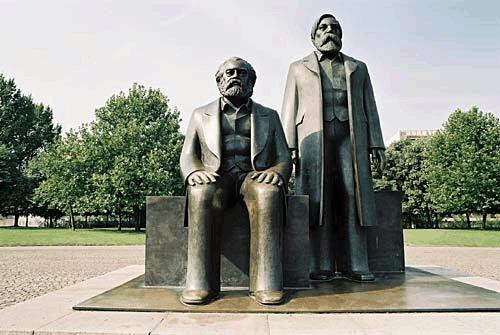
Don't get your briefs in a twist when I tell you that nothing can be further from the truth! Both Karl Marx and Friedrich Engels were entrenchedly prejudice - not simply against black Africans or their descendants as is often asserted, but of Jews, Slavs, and many others. Observe just a few quotes.
________________________________


Two villains of history

This young lady, who instantly overwhelmed me with her kindness, is the ugliest creature I have seen in my entire life, with repulsive Jewish facial features.

-- Karl Marx to Antoinette Philips (Letter, March 24, 1861)


****
...the Jewish Nigger, Lassalle... it is now completely clear to me that he, as is proved by his cranial formation and his hair, descends from the Negroes from Egypt, assuming that his mother or grandmother had not interbred with a nigger. Now this union of Judaism and Germanism with a basic Negro substance must produce a peculiar product. The obtrusiveness of the fellow is also nigger-like.

-- Karl Marx to Friedrich Engels (Letter, July 1862), in reference to his socialist political competitor, Ferdinand Lassalle
****
Russia is a name usurped by the Muscovites. They are not Slavs; they do not belong to the Indo-Germanic race at all, they are des intrus [intruders], who must be chased back across the Dnieper, etc.

-- Karl Marx to Friedrich Engels, (Letter, 1865)

****
We discovered that in connection with these figures the German national simpletons and money-grubbers of the Frankfurt parliamentary swamp always counted as Germans the Polish Jews as well, although this dirtiest of all races, neither by its jargon nor by its descent, but at most only through its lust for profit, could have any relation of kinship with Frankfurt.

-- Friedrich Engels, Neue Rheinische Zeitung, April 29, 1849
****
As for slavery, there is no need for me to speak of its bad aspects. The only thing requiring explanation is the good side of slavery. I do not mean indirect slavery, the slavery of proletariat; I mean direct slavery, the slavery of the Blacks in Surinam, in Brazil, in the southern regions of North America. Direct slavery is as much the pivot upon which our present-day industrialism turns as are machinery, credit, etc. Slavery is therefore an economic category of paramount importance.


-- Karl Marx to Pavel Vasilyevich Annenkov, (Letter, December 28, 1846)


Now put your fists up and praise your ideological fathers, ye black, Asian, Latin, and other non-Germanic, non-white Communists and socialist laborers for the dictatorship of the proletariat, the dictatorship of the master race, these men who hated you with all the vitriol and passion within their being!


The Specter Haunting the World


Marx, Engels, Lenin, Stalin, Mao
These men set the world stage for a century and a half of bloody totalitarian slaughter that has been unequaled in all planetary history. The specter haunting the world, to paraphrase Karl Marx, was not free markets, the rich, the middle class, nor those who create wealth.

The specter haunting the world is collectivism in all its heinous and destructive forms. The specter haunting the world is fascist socialism. And the specters of Nazism and Communism were its worst adherents in the history of the earth.


How Do These Two Philosophies Relate to Our Primary Thesis?

The Jainist doesn't believe there to be too much question in most people's minds that both Nazism and Communism represented two of the greatest forces for evil and tyranny in the history of the world. In fact it is my personal belief that International Communism was the worst of these two, and that it was the most heinous personification of evil ever faced by humankind to date.

Do not misunderstand.

I have no love for Nazism whatsoever!

I simply believe - based upon my own studies of the shear quantity of people killed, and the long, extended international reach of Communism, coupled with the fact that it was a more insidious, sophisticated, and subtler form of tyranny, and, finally, that the Nazis learned much of their techniques of enslavement from the Communists - that the international Red Menace was a far greater threat than history has given it credit for being.

To state my conclusion, however, Communism and Nazism, despite revisionist and apologist claims, destroyed the lives of nearly 130 million people combined. Nazism learned from its senior blood brother how to carry out the socialist cause, and Communism both preceded and succeeded Nazism in this endeavor long after the "Hitler faith" had been put down.

Both movements proved themselves a rabid, wild dog dedicated to conquest, murder, and domination.

If an individual can look at these atrocities and not regard them as acts of evil and tyranny, quite frankly the Jainist considers such a person inept in both their intellect and their moral conscience.


In the last part of this series we will devote ourselves exclusively to an examination of how these two abominations can be related to the Sith-Jedi conflict in the fiction of Star Wars. We will deal with the matter of good and evil as represented between the two Force orders, and how their age-old internal struggle set the fictional galaxy "far, far away" aflame. There are lessons.


Until then...


To the upward reach of man.
Tuesday, April 23, 2013

The Sith, the Jedi, the Ancient Force Religion, & the Two Great Struggles of Human History, Part 1

I want to get back to a meditation I previously sought to think on before the events of 10/1/12 and their subsequent aftermath.

This blog is to be on the conflict between the Sith and the Jedi, and its greater backdrop as an allegory to the larger, real-world struggle between good and evil.

Specifically, I'd like to explore what is, in essence, an internecine conflict of religious extraction that eventually spills over into a wider galaxy and enraptures it in turmoil, chaos, war, destruction, devastation, and despair.


The Two Great Struggles of Human History

To make the real-world connection, however, we must first ask the question: What are the two great struggles of human history? 

Put simply, these two great conflicts are those between good and evil and those between liberty and tyranny.  In fact, it is my personal belief that the struggle between liberty and tyranny is but a subset of the broader conflagration between good and evil.

I'll not examine too many real-world examples of these conflicts, though - in aiding our understanding of the fictional age-old rivalry between the two great Force denominations of Sith and Jedi - some examples will in fact be useful to that purpose.

But first, a delve into the philosophies of the Force's two primary sects.


The Ancient Force Religion's Two Great Denominations

Although there are many other Force sensitive beings in the Star Wars universe expressing and codifying their understanding of the ethereal power, the two most renown divisions of the Force philosophy remain those of the Sith and Jedi. And it is to these two once unified, but now fiercely divided groups, we shall first turn our examination.


THE JEDI CODE

There is no emotion, there is peace.
There is no ignorance, there is knowledge.
There is no passion, there is serenity.
(There is no chaos, there is harmony.)(*)
There is no death, there is the Force.


Yoda, master exemplar of the Jedi Code in the modern era 
Undoubtedly there are many great masters, many great heroes, of the Jedi Order who uplifted the galaxy and fulfilled their destiny as mighty Force wielders. These devotees of the Light Side believed in the passionless, emotionless 
expression of their connection to the Force, not as manipulators of this power, but as instruments of it. In other words, they believed themselves to be the tools of the Force, the living, fleshly embodiment of its will. 

THE SITH CODE

Peace is a lie, there is only passion.
Through passion, I gain strength.
Through strength, I gain power.
Through power, I gain victory.
Through victory, my chains are broken.

The Force shall free me.


Palpatine (aka Darth Sidious), unequaled
master of the Sith Code in modern times 
By contrast, the Sith are the undaunted devotees of faith in themselves alone, and in the Force as an instrument of their will in the universe. The Sith do not accept the obtuse notion that peace, equality, and selflessness are the paths to enlightenment and self-improvement. On the contrary, seeking ones own betterment, ones own desires, is the way of the truly enlightened being - even if such path must come at the expense of others. The Sith believe that the Jedi devotion to others is a mask for fear of themselves, and the unwillingness to face the truth of their own concealed lust for personal power. And while the Sith accept the Jedi as fellow Force sensitives, they frown upon both the individual and collective Jedi's reticence to use their power to coerce "the right" upon lesser beings, and to exalt themselves as masters and shapers of the greater good above the petty squabbles of those incapable of recognizing that they indeed must be lead to this enlightenment.

Put more simply: the Sith acknowledge that there are those born to rule, and those born to be ruled. They accept that those who embrace the Dark Side of the Force have freed themselves to this truth, and are thus ready to take upon themselves the burden of this manifest destiny.


And This Mysterious Power Called "The Force" Which They Worship?

Well, the Force is what gives a Jedi his power.
It's an energy field created by all living things. It
surrounds us and penetrates us; it binds the galaxy
together.

-- Obi-Wan Kenobi 


One could say that neither the Jedi nor Sith "worship" the Force, though some in both sects believe the energy a deity of sorts. It may, perhaps, better be said that the two sects revere the great mystical power and its presence in the material universe, yet for obviously divergent reasons and differing ends. 

Still, the Force, as Jedi master Obi-Wan Kenobi once said, is an energy field that permeates all living things. Indeed, it is both created by, and beyond all living matter, and can even encompass those things which have passed beyond the veil of death or non-material existence.

This knowledge - which both Jedi and Sith embrace - is at the core of being able to both understand and harness the Force's living power to its fullest aspects. And while the Jedi respect the principle that the Force is deep, abiding, and cannot be fully known, the Sith believe that the Force can and must be fully understood in order for an adept of its power to completely realize his or her utmost potential.


Jedi master Obi-Wan Kenobi in his later years
 One could then intuit that it is this separation of belief that defines the idea that "faith is the...evidence of things not seen" vs. the notion that one must "prove" or "test all things." For those who are unaware, the two above quotes are both of biblical extraction, and challenge us to accept the paradoxical view that one must have faith in what is ultimately unknowable while simultaneously seeking to prove the validity and reality of that which, in the end, cannot be fully understood vis-a-vis the limited capacities of finite awareness.

Is there, then, a true separation in this notion of faith vs knowledge? Or are they actually two sides of the same idea, but in much more subtle and deeper forms than the finite mind can perceive?

And based on one's answer to this question, can we not also ask: Is there, truly, a separation of philosophy between the Sith and Jedi? Or is it merely a separation of practice and form?


Before proceeding to the next phase of our meditation, let us consider these questions and the host of further insights they challenge us to explore. And in our next discussion, we will dive into a few real struggles between good and evil, right and wrong, and their relation to the fictional battle between the Jedi and Sith, and some of their manifestations in the Star Wars universe.

We shall also attempt to see how the real world sets itself as a backdrop for these conflicts, and what we can learn about our own individual and collective roles in history.

As always, our desire is to promote the upward reach of mankind in the real universe, and to inspire each human being to see him or herself as a manifestation of those transcending truths which bind us together. Ultimately, we seek to inspire every man and woman to envision themselves as actors in the real world, and not simply as passive observers of history.

Until next time....


To the upward reach of man.
Wednesday, March 27, 2013

Up, Up, Up, and Awaaaay!

Just a little quick note to let you know that the events of 10/1/12 have not, and will not, stop me from working through this series.

Epoc Enuma, Part 1: Shroud of Shadows is out!

After last year, and after searching for a new publisher to give a home to the Enuma series, I finally decided that waiting on someone else to bring this story out was a waste of time. 

I went for it myself! 

Using the tools and resources of Amazon.com's Createspace, I believed the time was right to go ahead. I was researching this for some time and thinking of the best ways to proceed.

And here are the results.

This is the first edition, and I plan on continuing to write the other parts until completion and publication. Head on over and check it out! You can see the cover, a sample chapter, my bio, and more.

This story is for all of you who have believed in me, knowing that I'd never quite until the goal is accomplished.

I hope you like these beginning efforts!

Also, stay tuned... there's other news that may be on the way.  I don't want to talk about it right now, but keep looking here for more!

Until then...


To the upward reach of man!