Showing posts with label captain. Show all posts

Sunday, January 10, 2016

Star Wars: The Force Awakens: Part 2, The Social Justice Crusade

I had originally planned to make this part two in my series on Star Wars: The Force Awakens. However I’ve decided to not wait until putting the finishing touches on the first part because I believe what’s revealed in the following meditation is central to the message of the new Star Wars. We were brought to theaters with the idea that we were to be engrossed by an entertaining sci-fi story that captured a generation’s imagination and which was set to do so for another. While that was true, there was another agenda. And it is that agenda I wish to reveal now. My original introduction to part two is below. Also, the original posting of this meditation is at my new Talagxaon blog.

**************************


I'm now going to talk to you about why I think this movie had an agenda, and a particular one at that, one that became glaringly obvious as I continued to watch, and which was confirmed in my later researches and readings on the subject. But, first, to set the stage, let's talk about the women who showed up in The Force Awakens, because it is indeed women who are the central focus of my insights into the crusade of this movie.

The Women of The Force Awakens


Princess Leia Organa-Solo

General Leia Organa-Solo
She is the one female holdover from the 1970s-80s trilogy, the feisty Princess Leia, Rebel Alliance leader and battle-hardened but emotionally tender soldier, the lost daughter of Anakin Skywalker and sister of Luke Skywalker, Force sensitive, the love interest of Han Solo. It is Princess, now General Leia who is the most credible female presence in The Force Awakens. In the course of things we learn several important developments about General Organa: she's now a key figure in the new galactic Resistance movement to the remnant Empire-First Order tyranny; she was once married to and is now (presumably) divorced or separated from Han Solo; and together they've had at least one child, Ben Solo, who is also the main antagonist of Episode VII, the ominous Kylo Ren, who desires to be the inadequate successor to his late Dark Side-fallen grandfather, Anakin Skywalker, aka Darth Vader.

But though seeing her again is cool, and though there is a very memorable and emotionally touching reunion between herself and Han Solo, Princess Leia is hardly used to full capacity in the storyline, almost appearing as another backdrop on which to overlay the new feminine mystique of the program, Rey. Though this is disappointing it is understandable from a storytelling point of view. However, many questions remain unanswered about Leia's development in the last thirty years of the timeline, questions I hope are answered as this final trilogy unfolds.

But how does my acceptance of Leia diverge from the others?
 

Captain Phasma

Captain Phasma, First Order military leader
Though we do not know it from the beginning, Captain Phasma is female. And we are only given to realize this when she reprimands renegade Stormtrooper Finn when he's finally starting to question his allegiance to the First Order at the outset of the story. Even Phasma's armor is androgynous in order to prevent the possibility of one discerning she's anything but a competent trooper, presumably male; and she never removes her helmet at any point either. So we only have her voice, which is unmistakably feminine. So be it. However, the criticism of this character is not that she's another girl, but the psychology involved in getting us to accept her on-screen presence, which is based primarily on clever but subtle concealment. From the armor that hides her female body parts to the helmet that cloaks her feminine facial features - and which, once removed, would demonstrate that the gig is up - we are given a character which the scriptwriters seemed afraid might be rejected were it to be shown too soon not to be male. 

OOPs, it's a GIRL! OH, MY GOD!  It's got boobs, it can't be a soldier!

Give me a break. 

Sure, undoubtedly, some audience members - male and female - would have a problem with this. But time and again we've observed the opposite to be true, whether it is in the dedication of fans to characters like Jedi Master and Council member Shaak Ti, Alice of Resident Evil notoriety, or the katana-swinging Michonne of The Walking Dead (my personal favorite character next to Rick Grimes himself!). So what was up with consistently keeping the identity and utility of Captain Phasma secret, as if she would be kicked to the curb and resented if it were revealed she was a woman? The only resentment (and I dare say, rejection) of this persona from most viewers would be that it's another useless creation of a female personality for the sake of creating a female personality, as opposed to one who is compelling and thought-provoking. And that itself has a reason which I will declare at the conclusion of the rest of our Women of TFA profiles.

Maz Kanata

Maz Kanata, the female answer to Jedi grandmaster Yoda
"I am not a Jedi," the short, orange Kanata states to Rey in a critical moment of TFA. But clearly she is a mystic of some report who is not only specially attuned to the Force, but is also mysteriously in possession of Anakin Skywalker's lightsaber, the same one given to Luke Skywalker by Obi-Wan Kenobi, and lost during Luke's duel with Darth Vader in Cloud City. It is Kanata who senses the lightsaber's call to Rey in the underground passages of her Mos Eisley-style bar and who informs Rey of her own affinity in the Force. Clearly, though she is not a Jedi, Maz Kanata is meant to be the wizened elder who reveals to Rey, however temporarily, a greater sense of her destiny to come, she who initially sets Rey's feet upon the esoteric path. She is the female equivalent to Jedi grandmaster Yoda (who similarly reveals to Luke Skywalker his own unfolding Jedi destiny) though Kanata herself has never trained to be a Jedi nor lightsaber combatant. To be clear, nothing in Star Wars lore mandates a Force user to be a Jedi. It is simply that these particular Force sensitives have always been front and center of its application in the Star Wars universe.

But is Maz Kanata's presence simply another bow to the fangirls of the series, another way to tell the female audience members, "Look, Star Wars is for you too"? With the plethora of women who repeatedly appear in TFA it can be argued just so, especially as two more, female spies - one for the First Order and the other for the Resistance - show up in Kanata's bar just as our heroes do.

On the right, one of two female spies featured in Kanata's pub
But, "What are you saying? Chicks can't be spies?" Sure they can! And history proves they can be very effective ones when trained properly. The observation here centers around the shear number of women we continue to see in the storyline and asks the reader to ponder why. 

Rey

Rey, the girl who can do anything...and better than any man
This is the desert scavenger who is the central focus of our story- though we are initially misled to believe otherwise. In fact, much of the run-up advertising and even the start of the movie itself misdirects the viewer to think that it is the character Finn who is not only the key figure in this new Episode VII, but also the one in whom, eventually, the Force will awaken. This turns out to be false advertising, and may in fact have been part of the kinds of misdirections which J.J. Abrams is famous for.

However, what we are treated to with the character of Rey is a young woman who is at odds with the universe around her, isolated, and somewhat maladjusted. Fine. Very good. Character traits we can get along with and which are interesting for plot development. Unfortunately, these things, which stand to be the "meat and potatoes" of the character, are only given marginal screen-time, and hardly explored. Instead what we are offered is how smart and tough Rey is. OK! Still fine character traits, but unbalanced with the others in favor of showing us just how strong, modern, and independent she is. Rey becomes, not a character in whom viewers can invest emotional attachment, and whom they may possibly be able to identify with, whatever their sex, but a caricature for the modern feminist woman who ballyhoos at every opportunity, "I don't need no man!" 

Combine these things with the fact that Rey can do anything from fix broken hyperdrive coils to piloting speeders and antique spaceships, to doing in the Force in days what it took more powerful Force adepts than she years to learn, including Chosen One Anakin Skywalker - a veritable genius Rey is! - and you have the perfect recipe for every sci-fi chickadee's dream, a girlie girl who can run circles around the boys while gleefully singing, "Anything you can do I can do better. I can do anything better than you!" And all while keeping her clothes completely on at that!

Social Justice Warriors, rejoice! You now have the sci-fi feminist icon you've waited forty years for!

TFA as a Social Justice Experiment  


Enterprise bridge officer Lt. Uhura, Star Trek: TOS, 1960s era

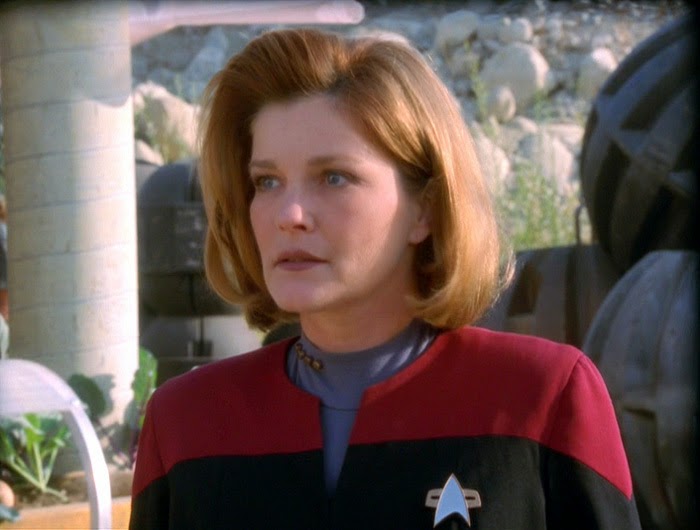
This is not to say that there's some kind of problem with intelligent, capable females. Indeed in Star Wars as in Star Trek and other sci-fi incarnations, there have been plenty of such type women - from female Jedi and Sith warriors like Ahsoka Tano, Luminara Unduli, Depa Billaba, and Asajj Ventress to women Starfleet officers like Kathryn Janeway, Jadzia Dax, and Kira Nerys; but knowledge of at least some of these awesome SF girls requires a slightly deeper effort to know than mere passive ingestion of television and films. They also require that we refuse SJW efforts to cast these ladies down a convenient memory hole in order to make a point when SJWs don't have one. Given such examples (and there are plenty more) is it then credible that feminist SJWs harp and cry that there are no authentic female sci-fi heroines they can relate to?

Or is it more credible to think that what many feminist SJWs, and their progressivist male allies, are really hollering for in science fiction is the presence of more white female leads and the unqualified worship/acceptance of such leads by men?

That stated, the notion that this observation is about denying chicks their "grrl power" in science fiction is absurd and should not be asserted by anyone objectively reading this criticism. However, we must ask why in TFA was there a consistent, ever-recurring theme to bombard and bamboozle the audience with image upon image of women in positions of authority and/or power, and, in the case of the character Rey, why this very underdeveloped personality was shown in scene after scene either outclassing or upstaging her male counterparts, including in areas where their own expertise was imminently greater than hers. Examples of this include her telling Han Solo how to fix a critical malfunction aboard the Millennium Falcon, a ship he was intimately familiar with before the gifted Ms. Rey was even born, and which she'd only just stepped foot on hours prior to his arrival; her rescuing Finn from the First Order assault on Jakku, and subsequently from the monsters aboard the Falcon; and saving Finn from death at the hands of Kylo Ren on Starkiller Base by besting the wanna-be Darth Vader 2 in a lightsaber fight.

And that example itself raises criticism. Any observing, thinking viewer has to wonder how in bloody hell does an untrained duelist, barely Force-conscious individual like Rey go from having no conceptualization of her own power in the Force to being able to suddenly, expertly "tap into" its living essence - essentially in a matter of days - so much so that she's able to Force Will a stormtrooper to release her from captivity on Starkiller Base and, later, to fight Kylo Ren - a trained and skilled Force wielder and lightsaber duelist - to a standstill though she had not prior experience nor training with either.

Clearly, and without objection, Rey is a talented being, one whose natural ability (particularly with the Force) can be likened to an individual with an "ear" for music, but who has yet to learn how to read music or control his/her own voice. She has raw, undeveloped talent which explodes onto the scene without explanation or cultivation. But she has no skill. And at some point her loosely-awakened, innate talent begins to stretch the boundaries of credulity.

But Why Repeat These Elements Ad Nauseum?


Star Wars was always a boys’ thing, and a movie that dads could take their sons to. 
And although that is still very much the case, I was really hoping this could be a movie 
that mothers could take their daughters to as well.

-- JJ Abrams

The answer, I claim, to not only the "girls are awesome" trope that runs through TFA, but also to Rey's overcompensatory coolness, can be found in the statements of both Lucasfilm CEO Kathleen Kennedy and Episode VII director J.J. Abrams, each of which has candidly asserted their desire to use The Force Awakens as a vehicle to promote the empowerment of girls and women in science fiction and the real world at large. And there is nothing wrong with this idea in principle; if women wish equal rights and privileges in society, that of course will entail full-fledged access to equal opportunity, with the accompanying equal responsibility and accountability to boot.

Linda Hamilton as Sarah Conner from The Terminator series
However, time and again social justice warriors, particularly of the white female feminist variety, attempt to convince us that images of strong, competent women in the media of science fiction (such as the 1960s Star Trek Lt. Uhura shown above) simply either do not exist or are so few and far between as to be inconsequential and unimportant, especially to the inspiration and imagination of girls and women. And thus, in order to compensate for this alleged inadequacy, we must be utterly overwhelmed in modern-day entertainment with this imagination-becomes-reality scenario: fiery but dignified women who can fight stronger and better trained men to the ground (or at the least, to a draw); sharp, intelligent chicks whose technological wizardry runs circles around their male counterparts; or, on the other side of things, cynical and potty-mouthed women whose sardony and sexual liberation puts even a drunken sailor's lifestyle to shame.

Sigourney Weaver as Ripley in Alien
But this perceived lack of "strong women in sci-fi" is not true, and further has not been for decades. I will not catalog every incarnation of tough, diligent female leaders in science fiction and fantasy over the last forty-fifty years, whether in film or print media, because to do so would require several pages. Suffice it to say the information is out there, and just doing a cursory search on the Internet will prove this case. So, again, the notion that there is some perceived lack of female role models for young girls and women to aspire to emulate in SF is just that - a perception - and an incorrect one at that, and one which continues to be demonstrably more untrue as the examples multiply in the fiction stories of the current era.

So, Ms. Kennedy, Mr. Abrams, was it so absolutely necessary to hound us with something that most intelligent SF adherents already know and which most of us have no objection to seeing? I argue not, and further that it would have been better for you to concentrate primarily on giving us a superior story that smoothly incorporated compelling female identities rather than a movie through which you wished to cram down our throats your Star Wars SJW experiment.

The Feminist Force Awakens


I don’t have many choices. But that’s going to change. Going forward with all 
we’re talking about there are going to be a lot of wonderful new [female] characters.

-- Kathleen Kennedy at Star Wars Celebration, 2015


The venomous Diana from the 1980s sci-fi hit, V
At the risk of redundancy, my objection to the profusion of women in The Force Awakens is not because they are women, but the function of these women as a tool of propaganda and brainwashing. It now appears that Star Wars will become a tool of political correctness and 21st century women’s suffrage rather than the grand operatic space adventure it was always meant to be. Women will not be incorporated into these stories because they are fascinating people with remarkable backgrounds to be explored. They will not add to the great themes of science fiction which examines the human condition and makes insightful commentary on that condition through the guise of futuristic, far-away space adventure. Their skills as fighters, leaders, or savvy scientists will not be earned nor developed but handed to them simply because… well because they’re women. It is an absurd proposition that we are asked to accept this stupidity, and even more absurd that an iconic series like Star Wars has been corrupted, sacrificed on the altar of political correctness, female insecurities, and feminist lunacy.

Kathleen Kennedy and J.J. Abrams saturated TFA with women because their agenda to see women front and center of the sci-fi phenomenon was greater than their desire to tell a genuine, original story that paid homage to this giant of speculative fiction entertainment. Their aim to feminize Star Wars on behalf of a social justice crusade should not be accepted by those who’ve come to love it and its message of liberty, justice, and epic excitement.

Cmdr. Susan Ivanova, 1990s sci-fi adventure, Babylon 5
Further, there was utterly no need for this kind of brainwashing for, as stated earlier, the examples of the types of sci-fi women Kennedy and Abrams would have us believe do not exist have in fact existed for years and decades, and in plenty quantity. They have been heroines, villains, geniuses, morons, saints, whores, and everything in between. In other words they’ve been human characters with the requisite flaws, nuances, and ambitions necessary to create personalities of depth whom audiences could love and hate. Therefore the idea, as Kathleen Kennedy seems to erroneously believe, that there are few women in science fiction she and other female humans can identify with is ridiculous and unfounded on its face. It is a foolish perception that should no longer be accepted by those with knowledge of science fiction history and enough memory to count, or for those with just some basic research skills.


In my next post on The Force Awakens I will delve into the other principal characters and what I thought of them and their relationships to the overall arch.


Until next time...


To the upward reach of man.
Wednesday, September 23, 2015

The Leadership Principle: Starfleet's Finest in the Captain's Chair, Part 2

In our last blog we discussed the leadership styles of Captains Kirk, Picard, Sisko, and Janeway and how each of them expressed their unique command abilities with respect to the starships they served. Let us now turn our attention to how each of these captains were a representation of the real-world times in which they were portrayed on the small, and in some cases, on the big screen.

Captain Kirk: The Fighter, the Hero, the Aggressive Commander


James Tiberius Kirk
These four captains' styles of command are as individual as they are, and, the Meditator believes, are all representative of the times in which they led their respective starship crews. Of all that we may contrast distinctly due to the era in which he commanded, Captain Kirk must stand alone for several key reasons. Captain Kirk's Enterprise represented a Starfleet in which the galaxy was less explored, human technology less developed, and, in my opinion, certain rules of Starfleet and starship culture were less strictly defined and enforced. Also, in Kirk's time the Klingons were avowed enemies, as were the Romulans. In other words, James Kirk lived in a Starfleet more aggressive than that of our other captains.

Consider: In 1960s America we were aggressively dealing with the Soviet Union and International Communism; race issues domestically, including riots and the Civil Rights movement; anti-war movements, such as that against Vietnam; and counter-cultural reactionism against the Establishment (Hippie "Flower Power" and "Free Love" are examples of that). All of these subjects were tackled in one way or another by the original series.

Yet even through these seemingly insurmountable problems, the America of the 60s represented a nation more confident of itself and its values than of today. It was a country more firmly centered in classical ideas of Western Civilization as they were then understood, and thus it was a nation that stood firm in its outlook, even when faced with external and internal turmoil. The Meditator affirms that such outlook was reflected in the 1960s Star Trek and personified specifically in the person of Captain James T. Kirk.

None of this is to say that James T. Kirk was a hyper-aggressive brute out to shed blood and start conflict any chance he got, but to illustrate how the personality of this superbly dynamic Starfleet officer reflected both his fictional and actual world environment.

The 24th Century Commanders: Thoughtful, Diplomatic, & Dynamic


Jean-Luc Picard
By contrast, the Starfleet of Picard, Sisko, and Janeway is a much more settled institution, with rules and regulations befitting that of a more organized and mature space exploration agency. Thus, in your writer's opinion, we see a far less cavalier and grittier Starfleet than we do in Kirk's time, at least on the surface.

Comparatively, the three 24th Century captains themselves were dramatized during less turbulent times in both the life of the American nation and that of the world as a whole. While Picard is perhaps the most cerebral and intellectual captain to date - possibly only being surpassed in that mantle by Janeway due to her scientific background - he nonetheless represents a calmer, more thoughtful, less aggressive Starfleet as a whole. Picard is emblematic of a Starfleet that is at overall peace with the known galaxy, and offers a more diplomatic perspective on the application of force than does Kirk.

Ben Sisko
In the real world, the Treks of TNG, DS9, and Voyager represented an America financially prosperous, internationally stable, and more or less socially cohesive on the homefront.

As an example let's briefly think about the first Gulf War which occurred during TNG's run in 1991. Here was a conflict that ultimately set the stage for the toppling of the Iraqi regime of Saddam Hussein in 2003. Yet, as historically notable as it was, Gulf War I paled in comparison to the monumental and world-altering 9/11/01. Indeed, 9/11 had not yet occurred even while Voyager was still on the air; in fact, Voyager had completed its seven-year run by the time September 11th happened. The last series to date, Star Trek: Enterprise, had the distinction of being on-air when the attacks took place, and of dealing with the event in a fictional counter-portrayal.

Even during the time of Ben Sisko and DS9, the Dominion War was not a representation of any real-world conflict of note, but a fictional portrayal of the ongoing expansion of influence of the human Starfleet and its interaction with the Bajoran and Changeling peoples. And though we might claim that out of all the 24th Century captains, Sisko was certainly the most passionate and dynamic, even this Starfleet officer tempered, and was tempered by, his environment and circumstances. In this regard, I've given considerable space to why I believe Sisko perhaps the most well-rounded character of the new captains. Please feel free to review it.


Kathryn Janeway
It is also worth noting that during the Janeway years, Voyager's encounters with the Borg Collective did not represent any major true-to-life events, but, once again, the continuation (and furtherance) of a conflict began with the introduction of the Collective in the TNG episode "Q-Who." The journeys of Captain Janeway and her crew to get back to the Alpha Quadrant were certainly interlaced with danger and hardship, yes, but represented the on-screen excitement of pure adventure and the exploration of space which Starfleet was created to advance. Does any of this mean that Janeway stood out less than Captain Kirk?

Does it mean that any of the 24th Century captains stood out less than Kirk because they occupied times that were less dynamic in their fictional portrayal of reality? The Meditator thinks not. Any and all of the 24th Century starship leaders proved beyond doubt that they were more than capable of holding their own and giving back as good as they got in all areas of starship command life. They proved that the Starfleet of their time was no less courageous, no less human than that of Kirk's. Indeed, Starfleet, like its captains on the bridges of their majestic vessels, had become more sophisticated and savvy about the universe and the wonders within.


This is the Captain Speaking...


Kirk, Picard, Sisko, & Janeway
The four Starfleet officers we've studied here represent profiles in character, courage, understanding, and leadership on multiple levels. And, in your writer's opinion, they show that the Treks of the late 80s through the early 2000s were quite in contrast to the societal upheaval taking place in the American 1960s or the economic and international uncertainty of today. The more aggressive and passionate Captain Kirk, and his Starfleet, was a reflection of the American times in which he was created. And so was Picard, Sisko, and Janeway, but from obviously different perspectives. Your writer reiterates that these captains' attitudes were a reflection of the real-world times in which they were portrayed.

What will the next Star Trek captain be like? One cannot say specifically, but if Trek tradition continues to hold sway, he or she will almost certainly be a mirror for the American and planetary condition of their time.


Until next time...


To the upward reach of man.


*******************

For those wondering: Why no analysis of Jonathan Archer and the crew of Star Trek: Enterprise? As before, when I first began this meditation, I explained in part one that I rarely watched this series when it was on broadcast TV (and still have not to this day) and thus cannot be as easily insightful with it as I can with the other Star Treks. Perhaps I will actually sit down and watch Enterprise from beginning to end one day and do for it what's been done in this group of meditations. We'll see.

Tuesday, October 15, 2013

The Leadership Principle: Starfleet's Finest in the Captain's Chair, Part 1

In the Star Trek sci-fi universe there have been five well-loved series. In each of those series, five iconic Starfleet captains have commanded the bridges of mighty Federation starships powered by the imagination of their viewers. With this meditation, I'd like to use three of those five captains as a means to explore what is commonly called "the leader principle." Here, we'll examine what it means to be a leader through the eyes of the legendary Captains Kirk, Picard, and Sisko, and how each of these men inspired their crews through dynamic personal leadership. Furthermore, we'll look at what this means in the real world, and how we might each benefit from a study of these classic leader types, fictional though they may be. 

So, fellow officer, take a seat in the captain's chair as we jump to warp speed and begin.


James Kirk

"I don't like to lose."
-- Admiral James T. Kirk

Without question one of the most iconic science fiction heroes of all time is the legendary *first captain* of the Starship Enterprise, James Tiberius Kirk. Known as a man of action, Captain Kirk is a leader with presence who doesn't take no for an answer, and who doesn't suffer defeat gladly. As a young cadet, Kirk proved the latter by famously rigging Starfleet Academy graduates' most despised command test of all, the Kobayashi Maru, enabling him to become the only Academy superstar to ever beat "the no-win scenario," for as Kirk himself would say many years later, "I don't believe in a no-win scenario." 

How did he do it? "I changed the conditions of the test. I got a commendation for original thinking," he says to the inexperienced Lieutenant Saavik in The Wrath of Khan. Throughout the Original Series we see a Captain Kirk who time and again beats back death, beats back defeat, saving the day not only for (and with the help of) his gallant crew, but also for Starfleet's noble ideals, and the safety and security of the galaxy itself.

Yet even Captain Kirk is powerless to forever hold back the hand of fate. Twice in the original crew movie series James Kirk faces what for him become the ultimate losses in the form of the death of his most beloved friend, the Vulcan science officer, Mr. Spock, and the destruction of the one true "lady" in his life, the great Starship Enterprise herself.


"I Don't Like To Lose."

Yet even these "defeats" are not enough to break the man, the captain, the leader that is James Kirk, for, as Dr. Leonard "Bones" McCoy reminds him after the destruction of the Enterprise, Kirk always finds a means to "turn death into a fighting chance to live." He does it when the original Enterprise meets its end in The Search for Spock. And he does it when given the chance to return his best friend to life when it is discovered that Spock has been regenerated on the Genesis Planet.

What principles of leadership can we learn from Captain Kirk?

The greatest lesson I think Kirk shows us is that there is always a way out of a "no-win scenario." To find it takes courage, imagination, cunning, ingenuity, determination, and above all, the will to overcome. Captain Kirk demonstrated these traits repeatedly and in abundance during his Starfleet career, facing down many impossible scenarios - from military to diplomatic to scientific - and proving that the will to prevail shines brilliantly within the human spirit, and is capable of overcoming all obstacles if we are but willing to listen and heed it.

Of course there are many more leadership traits that we could examine with this heroic Starfleet commander. But our focus was to take his core traits and collapse in on a few key examples of how they make Kirk the man he is and why his example is worth emulating.


Jean-Luc Picard

"Make it so."
-- Captain Jean-Luc Picard
 
Following on the heels of his predecessor, the noble captain of the Starship Enterprise-D is our second model for consideration. Jean-Luc Picard is a renaissance man in the finest tradition of the term. Picard is a philosopher; amateur musician, painter, and actor; accomplished diplomat; skilled fencer; trained archaeologist; a student of history; an enthusiast of the natural sciences, particularly the astro and temporal sciences; and, of course, the highly respected and successful captain of the Federation flagship. He is a type of the best of the human species and of human potential which even the superbeing Q recognizes as true.

Picard exudes leadership by first demonstrating the best, and then demanding and subsequently expecting the best from his crew. He inspires his people to go out of their way for him because they recognize that they act in the name of the best Starfleet captain of the modern era. His example of thinking before action has led the Enterprise-D out of treacherous situations on multiple occasions. This is has been especially true in matters of interstellar standoffs where reflection, calm, considered judgment, and reason have prevented armed conflicts from ensuing - both military and political. And one of the greatest examples of Picard's ability to see the "big picture," to use his deep knowledge of the human condition to look down the long tunnel of history and avoid unwarranted bloodshed, is when fellow Starfleet captain Benjamin Maxwell unjustifiably attacks Cardassian territory to the end of preventing what he believes is a clandestine Cardassian military rearmament and future assault
upon the Federation. Picard prevents Maxwell from taking Starfleet and the Federation to war against the Cardassian Union without the firing of a single shot against neither the rogue Starfleet captain nor the Cardassian forces. Yet Picard does not idly dismiss the warnings of Benjamin Maxwell, nor the evidence - albeit specious at best - which he has produced to support his accusations. Picard goes on, in diplomatic, but firm, unadulterated language to warn the Cardassians that Starfleet will be on guard.

Yet a second example is the defection of Romulan admiral Alidar Jarok. Moving to investigate an alleged plot by the Romulan Empire to provoke war, the Enterprise is requested to determine if the supposed evidence of apparent defector Admiral Jarok is true. Picard rushes into the Romulan Neutral Zone on Starfleet Command's orders only to discover that the Romulans have staged the entire affair using the duped Admiral Jarok as an unwitting pawn in a devious machination to frame the Federation. Though Picard is in direct violation of the Federation peace treaty with the Romulans, and though the Enterprise is completely surrounded by enemy vessels and cut off from escape, Picard demonstrates the forethought and superior understanding of Romulan psychology to prepare for such possibility well before entering Romulan space. He again saves the Enterprise from destruction, Starfleet from an unwanted conflict, and the Federation from intergalactic humiliation by the cunning use of a brilliant tactical counterploy alongside the Federation's interstellar ally, the Klingon Empire.

Though we have focused on two military examples of Picard's leadership, the core trait that Subspace Meditator sees - which is in fact demonstrated well and beyond Picard's skills as a military commander - is his ability to think through a situation deeply before taking action; his ability to see multiple possibilities and multiple probabilities, and further, to deduce from these the best likely scenarios with which to guide his crew to the successful completion of their mission. Alternately said, Picard has a well-honed ability - derived from years of experience as a field officer - to foresee a myriad of options and collapse in on the few (or one) that will bring the Enterprise home.

Subspace Meditator believes that, more than any other trait Picard manifests in the TNG era, this trait is what distinguishes and separates him from his counterparts in the Star Trek universe.

And a superior trait it is to have indeed!


Benjamin Sisko

"There's only one order... We hold."
-- Captain Benjamin Sisko


Of course, longtime fans of Trek film and TV will know that Benjamin Lafayette Sisko is not the first nor last individual of African descent to be shown in Trek programming, so his presence in this regard is not unique. What is unique in that regard is that he is the first to be regularly shown in Star Trek episodic television. And this opportunity gave actor Avery Brooks a unique canvass upon which to paint Ben L. Sisko. Let's return to that fictional canvass and highlight some of those areas as well as the leadership style and core traits that make Sisko who he is, and not simply as the "black captain," but as an outstanding Starfleet officer.  


Family Man & Intimate Friend

Though it is known from other Trek lore that Starfleet does not discourage nor mandate its officers from having families, Ben Sisko is the only officer ever featured in its mythology to actively have one. All other episodic captains have been single. So Sisko's relationship to his son, Jake, is quite unique to explore from a storytelling point of view.

But let's back up.

father and son, Benjamin and Jake Sisko
Sisko is not simply a single father, but a widower. Having lost his wife at the climactic Battle of Wolf 359 in which Starfleet confronted the Borg invasion of Earth, led by the Borg-transformed Jean-Luc Picard, when the DS9 series opens, we find an emotionally lost Commander Sisko struggling to come to grips with Jennifer Sisko's death, a transfer to a recently abandoned Cardassian base far from Earth, and a very young teenage son whom he must now raise alone. For the first time in Trek history we are given the chance to see what Starfleet life is like for the married and attached individual. The heartwarming aspect of the father-son relationship across the seven years is how both come to terms with the severance of the husband-son roles neither will ever have or play in the life of their deceased loved one again. Benjamin and Jake learn ever-the-more to lean on each other, both imparting lessons to one another just as real parents and children do. What is most satisfying about this relationship to the Meditator is watching the boy Jake mature into a young man. And what assists this satisfaction best is to see it through his father's eyes. Whether teaching his son to cook his own meals, or about the "fairer sex," or giving him lessons in what true courage on the battlefield (and in life) means, or whether it is teaching Jake to know and be true to himself - no matter what others' expectations are, including his father's - this relationship brings out the best of what it means to be a dad, a mentor, a friend. It is especially heartwarming for those of us who have shared this bond with our fathers. And instructive to those of us who have not.


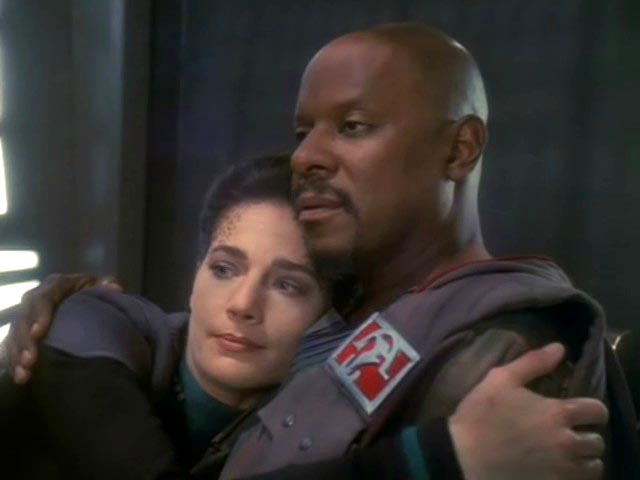
Jadzia Dax and Ben Sisko
The relationship of Captain Sisko to his son is only paralleled by the relationship to his Trill friend and mentor, Dax. We learn that the centuries-old symbiotic creature Dax is capable of assuming the host bodies of various individuals over the course of their lifetime. We also learn that the creature shares the experiences and memories of these persons, imparting to each new host the life lessons of the previous. As DS9 opens, we're introduced to the latest Dax host, Jadzia. Herself a trained scientist, the young Jadzia is recently bonded to her Trill symbiont, and reuniting with Sisko for first time in many years. She is pleased, as is he, to be joining her new superior officer in Starfleet's bold new venture to bring the recently-freed Bajoran star system into the Federation. She informs him that the previous Dax host, Curzon, has died, but that she shares his memories of a much younger and inexperienced Ben Sisko, and how Curzon mentored and shaped his worldview and future career. The relationship between Jadzia Dax and Sisko progresses over the next six years until Jadzia is sadly killed at the hand of Cardassian captain, Gul Dukat. What is fascinating, however, is that, before her premature death, Jadzia - in the form of her symbiont - continues to mentor the now much more seasoned Sisko. Yet, simultaneously, Sisko does his own mentoring of the young woman herself, returning the lessons in the form of experience she, as a being independent of her symbiont, has yet to have on her own. Across the breath of the series the contrast becomes quite satisfying as the viewer is given a glimpse of the extended family-friend relationship which the two have. 


Emissary to the Prophets

One of the most intriguing aspects of Ben Sisko is his special relationship to the Bajoran people themselves and to their deities, the Prophets. Known as the Emissary to the Prophets, Sisko is reluctantly introduced to the role Bajor will come to expect of him when he first arrives on DS9. As we learn, Sisko does not want it and is extremely reticent to assume the figure of religious icon to the deeply spiritual Bajorans. It is a part which Starfleet itself will always have difficulty accepting and which Sisko will continually struggle to balance between his life as an atheist human Starfleet officer and the need to strengthen the Federation's ties with the Bajoran people. Such a balance, though continually tested and uneasy, is achieved. And as DS9 continues, Sisko uses this special relationship, long ago foreseen and "prophesied" of by ancient Bajoran seers, to guide Bajor through some of it darkest hours. Sisko meets the Prophets on numerous occasions, joining them in the non-corporeal realm outside of time and space which they inhabit to consult with them, to receive guidance and instruction from them, and even to teach them on occasion what it means to be a creature that exists within time and space.


War Leader & Superb Strategist

Deep Space Nine became the focal point of the Federation Alliance's efforts to repel the Dominion invasion and occupation of the Alpha Quadrant during the Dominion War. On the front lines of this herculean effort was Ben Sisko himself. Tasked with planning and strategizing some of the fiercest engagements of the war, Captain Sisko led DS9 and Starfleet through the blood and horror of billions dead, but trillions liberated from the tyranny of the Changeling Founders' vision of order in the galaxy. The Dominion War was not an easy time for Sisko. Throughout this conflict the captain would not only see many of his crew killed, including Jadzia Dax, but his personal morality and principles as a human being and Starfleet officer would be put to the ultimate test more than once. He would see more conflict than he ever wanted and share in the pain, anguish, wrath, and sorrow of war all soldiers feel. Yet, leading his people through the conflagration, Sisko never lost touch with what it meant to be a man, a human being capable of seeing and feeling the human factor.


The Human Equation Not Forgotten

All of these roles serve to make Ben Sisko one of the most impressive characters and captains in Trek and Starfleet history. Indeed, it may be argued that he is the most unique persona to be conceived in the scope of the franchise. The above aspects of Sisko, Subspace Meditator believes, make him a much more well-rounded character, giving him an edge in observing, and applying, the human factor to all of his endeavors as a Starfleet officer. Sisko's humanity is never left behind, nor his mental and emotional state a mere afterthought. They are directly applied and demonstrated - indeed felt - whether in the loss of Jadzia Dax, the growing pains of his son, the struggles of the Bajoran people to rebuild after decades of slavery and occupation, or the triumphs and tragedies of the Dominion War. He is a complete man, making his leadership style an example of what it means to be a whole individual.


Special Profile: Kathryn Janeway

"Get this crew home."
-- Captain Janeway to Cmdr. Chakotay 


I wanted to include the captain of the Starship Voyager because one of the most unique aspects of Kathryn Janeway's appearance in Star Trek history - in my view at least - is, not that she's a woman, but that, of all the heroic captains portrayed in the five series, Janeway alone was a superbly skilled scientist and mathematician, in addition to being a Starfleet captain. This is depicted again and again in Star Trek: Voyager and is certainly impressive, for Janeway utilizes these skills on numerous occasions to keep pace with - and in fact surpass - her chief engineer, tactical officer, and many others whose scientific and technical skill our other Starfleet captains have merely relied upon to provide expertise.

As an aside, while her appearance as a female isn't unique for much the same reasons Sisko's isn't as a black officer, it would be remiss of us not to notice that, for the first time in Trek history, a female captain becomes regularly featured on the bridge of a Federation starship in the person of Captain Janeway, making her, just as Sisko, another Star Trek milestone.

It should also be noted that Janeway's epic seven-year struggle to return her crew to the Alpha Quadrant after Voyager is stranded in the distant and unexplored Delta Quadrant, makes her one of the most gallant and enduring Fleet officers to ever don the uniform. Janeway and Voyager are thrust into an unknown and dangerous space fraught with perils the likes of which no human eyes have ever seen before. And seventy thousand lightyears from home, she and her crew are the farthest any human vessel has ever traveled inside the Milky Way. In such conditions many would be tempted to give up, find the nearest habitable planet to settle on, and call it the next hundred years.

But Janeway does no such thing.

She pushes the Voyager and its crew to never settle for anything less than seeing Earth and the Alpha Quadrant again. The journey is not easy. Nor would Janeway, undaunted explorer she is, have it be. With none of the Federation's resources, none of Starfleet's armed might to back them up, Voyager does not set a direct, non-stop course for Earth, but takes many detours and assumes many missions, charting the Delta Quadrant, its uncounted species and dangers along the way.


USS Voyager's flight path for visual purposes. Far away in the vast reaches of space, Janeway never gives up.

Invincible Borg Fighter

Part of that legacy is Janeway's continued battles with the Borg Collective. Time and again assaulted by the ruthless and unmerciful will of the Borg to assimilate Voyager, Janeway adroitly, and with ever renewed vigor, finds new and innovative ways to confront and defeat them. But this is not only in terms of military strategy, for Janeway must also confront Borg cunning and maneuver in the person of the Borg Queen, she who is the Collective's central mind and governor. It is Janeway who defeats the Queen and takes from her the rescued assimilated human, Seven of Nine. Janeway who preempts Borg efforts to attack and defeat the superior Species 8472 while simultaneously preventing an invasion of the Milky Way galaxy by the aggressive race itself. It is Janeway who more than once thwarts the Borg Queen's efforts to assimilate weaker races, and who frees other assimilated drones from the grip of the Collective. And it is Janeway who destroys the Queen's entire transwarp hub complex, crippling the Borg's hyperspace routes throughout the entire the galaxy for decades.


"But You're a Mother to This Crew"

Q once called Janeway a mother to her crew, the woman who held Voyager's morale together through an array of impossible odds, keeping her people together as a family cast away on a stormy and tempest sea. And in some ways the Meditator can agree with Q's praise and his comparison, especially in observing the nurturing relationship between Janeway and Seven of Nine. But beyond such accolades, Janeway is a proven leader with the skill, the tenacity, the drive to succeed whatever the odds, and no matter how insurmountable they may seem. This drive places her in the best ranks with the elite of Starfleet's center chair commanders. Indeed, the Meditator says that USS Voyager's seven-year odyssey revealed Captain Janeway's strengths in a way that mere service in the Alpha Quadrant would never have. It raised the honorable captain's pedigree because it forced her to run faster, reach higher, strive harder, never quitting until the race was won. This is the finest of Starfleet tradition and Kathryn Janeway is in numerous ways an exception to advancing that tradition!

And this, the Meditator thinks, is the principle lesson to be learned from Janeway: that to be the best one must step out of the norm, the familiar, the comfortable. One must go beyond the acceptable and known, casting away fear, and sweeping boldly into what is unknown. If an individual can do this, is willing to do this, they can distinguish themselves in human history. Captain Janeway most certainly did!


In our next blog on the four captains, we shall compare and contrast their style of leadership and what we can continue to learn from these examples with respect to how each fit in with their era on the small screen.


Until next time...


To the upward reach of man.


------------------------------------

*I know that some of you hardcore Treksters will say that J.T. was not the very first captain of the original Enterprise. Chris Pike was. Some of you will even go back to Captain Robert April. Guess what, Trekkies? I know that! I'm a Trekkie too! But for the sake of argument and popular knowledge, I am listing James T. Kirk as the first acknowledged skipper of the Enterprise, OK?

**I did not include Captain Jonathan Archer in this analysis simply because I did not watch the show with the same frequency or intensity as I did that of the others. So I cannot be as readily insightful with respect to Archer's boat as I can with Kirk, Picard, Sisko, or Janeway. Sorry Enterprise fans.

Wednesday, August 1, 2012

Another Look at Star Trek: TNG’s “Code of Honor”

Lutan.jpg
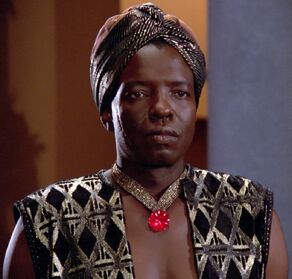
Jessie Lawrence Ferguson as Ligon II ruler Lutan
The Star Trek: The Next Generation first season episode “Code of Honor” is perhaps considered by most as one best never filmed, or, at the least, best left to drift down the galactic black hole and be agonizingly split apart atom by atom and molecule by molecule.

However, I have a different take on this (IMO) under-appreciated, and indeed, hated episode than most.  Indeed, I’ve only seen a scant number of reviews to date that even attempt to try and highlight this episode for what it did, or at least tried to do.

No, “Code of Honor” is not one of my favorite episodes, but when I run across it when getting nostalgic for the good ‘ole days of the Enterprise-D, I do remember my first impressions of it as a kid. Admittedly, I’ve always wanted to know what other fans thought of this episode, both older and younger. Thanks to today’s technology, I can both discover and share in that curiosity.

Let me give an angle on CoH that I think most either miss or gloss over in berating this episode with such fiery passion.


Uncharted Ground: The Star Trek Way

I remember watching “Code of Honor” in 1987 in junior high school. I was too young to appreciate all its flavors then, but I’ve had 25 years to think about it.  And, coincidentally, just recently, I was re-watching an old recording of TNG and ran across this episode by chance. My first impression as a kid was: “Wow! Black people are being shown as a species on Star Trek: The Next Generation!”  I really couldn't believe it. “Why?” you might ask. And by today's standards, in today's world, where America now has its first-in-history black American president, one reasonably could wonder why I'd be impressed, especially as a kid for whom skin color and race consciousness was never important.  I accepted universal humanity as my family, had plenty of friends from all groups and races of people, and never had a prejudiced outlook of any kind.

So, those things being said, why the surprise with this episode?

Well let’s ask this: Since when, before or later, have serious SF fans ever seen depicted in Star Trek (on TV or in movies) an all-black alien people? Sure, we know that ST isn't about "racial issues" per se. Sure, we know that the humanity of the 23rd and 24th Centuries is waaaay beyond that primitive nonsense. But did we ever see, before or after CoH, a species that wasn't all (or mostly) depicted as “white?”  I'm sure this was not due to the conscious thought of Gene Roddenberry or Rick Berman, but was probably due, quite frankly, to pressure from the Paramount execs “upstairs.”

But also consider this: Never before, or since, has any SF TV or movie series depicted an all-black people(s) of culture and influence in the universe anywhere.

At least not to my knowledge.

And, further, it has only been hinted at in one other SF show I'm aware of.  In the fifth season Stargate SG-1 episode “Menace,” we are introduced to the black female android Reese who destroyed her entire civilization and was ultimately responsible for creating the deadly Replicators.  Did anybody else even stop to think about that but me?  Was she a representation of her people’s actual physical coloration?  Was this the intention of the writer(s) to *hint, hint, wink, wink* that the species who inadvertently created the Replicators were a black people?  I don't know.  One could assume such. One could also assume the opposite – that she was merely of a biologically diverse humanoid (or even non-humanoid) people of some kind.  One could be right or wrong either way.  Nonetheless, that’s how it came out on screen (btw with no hint or indication at all from the SG-1 show that it was meant to be conceived that way by the audience).

TOS episode "Plato's Stepchildren"
Still, the fact remains that TNG did by implication showcase an entire race of black people.  Thus you can probably more easily understand my reaction in 1987.  And so I applauded this groundbreaking moment in its history if for no other reason than it was Star Trek: TNG that did it, just as it was Star Trek: TOS that broke ground with the first interracial kiss between Captain Kirk and Lt. Uhura in the 1968 episode "Plato's Stepchildren." Other programs may have come along and done it later (which, again, I've not seen yet – with any other group of people), but Star Trek: TNG did it first.  My show, the Trek program for my generation, in my time. How exciting!


The Ligonians as Representatives of Interstellar Black Sophistication

In this episode we see a strong, powerful, advanced, culturally and technologically sophisticated black civilization. They are not as advanced as the mighty United Federation of Planets, but they are not stone primitives centuries behind either.  Further, here are blacks capable of governing themselves without the aid or interventions of the advanced, colonial “white man,” his notion of "manifest destiny," or its cousin idea of the “white man’s burden.”  In fact, a strong anti-colonialism theme is subtexted into the program.

The Ligonians do not require the Federation to come along and civilize them for they are already civilized of themselves.  This is a culture ancient in its history, long-rooted in its own traditions, morals and ethics, and outlook upon the universe. 

More, the Ligonians are of sufficient scientific progress that they are deemed evolved enough for Federation contact.  Although this is not depicted in the story, the Ligonians are obviously advanced in the bio-chemical sciences for they have harnessed and cultivated a life-giving vaccine which the Enterprise is requested by Starfleet to negotiate for, and which formidable Federation science cannot at present replicate.  Further – if we follow other Trek logic to conclusion – the Ligonians have obviously developed space travel and more, warp velocities, for we know that Starfleet’s policy of first contact requires a civilization to possess warp-capable vessels.

Lastly – though this too is not fully explored or expounded upon in the show – we should assume that the Ligonians are a united people.  That is, that their entire planet (and/or multi-planetary civilization) is united in its socio-political disposition, and that the harnessing of planetary/interplanetary resources has been achieved.  The reason we should believe this is that it is stated in CoH that the Federation is requesting the Enterprise to negotiate a treaty for the Ligonian vaccine.  And we know from subsequent TNG programs (and older TOS ones) that before the Federation makes contact with a world, a certain level of global civilization is examined and expected prior to initial first contact.

It would be interesting to have seen CoH conceived and done in a more mature TNG environment (say in the third, fourth, or fifth years) where TNG had found its footing as distinct from TOS and had better writers and directors.  It would also have been quite revealing, I believe, to have revisited Ligon II to discover more about Ligonian culture.

Personally, this writer would have liked to see CoH approached in a different, and perhaps more sophisticated way.  But not by changing the Ligonians’ skin color or fundamental culture!  Instead, a cleverer CoH may have portrayed the Ligonians as a silent but important strategic partner outside of the Federation, yet needful in galactic affairs.  This could have been done whether by political, military, or scientific means (such as the medicinal storyline already used in the episode). 

Also, by ridding the Ligonians of some of their more antiquated cultural expressions - the “counting coup” idea (which this writer found ridiculous even then); the ancient (but not continent-wide) African tradition of ritual scarring; and lastly, the presentment of the Ligonians in what amounts to  13th Century Indo-Persian clothing (and Lutan as some kind of quasi mani sultan or "honored monarch") - I believe this culture would have been viewed as much closer to the Federation than they were portrayed.  Your commentator also suggests that such angle would have made the Ligonians much more endearing to the audience as well, and would have provided endless fertile ground for philosophical discussion thereafter.  It would have also perhaps made this one of the more memorable first year episodes still talked about today, especially because the featured non-Federation species turned out to be an all-black people.

Instead we got what I believe from a more mature perspective to be an ill-approached and poorly-executed episode that indeed did make use of an 1860s-1950s European and American colonialist view of blacks (and other peoples) the world over – as primitive, backward, and in need of the white man’s shepherding to survive and advance.  It was as though someone at Star Trek: The Next Generation could not use their imagination and project historical and fictional lines to come up with a black people that would in fact have been worthy of a space opera.  Whether this was the fault of former director Russ Mayberry alone or not is a question for historical debate, though several TNG actors seem to share this notion.  And yet, even with the above criticisms, I still ask if CoH was attempting some actually quite radical themes.


The Greater Real-World Implications of Ligonian Sophistication

Brown children must be able to participate in contemporary mythology.
-- Avery Brooks, 2008


It would not be until Star Trek: Deep Space Nine some six years later that the Ligonian phenomenon was replicated, on a far less grand scale and by far less number, in the person of Commander Benjamin Sisko.

Avery Brooks as Captain Benjamin Sisko of Deep Space 9
Acknowledging the power of myth to reshape reality, it was Rick Berman who personally stated on a QVC telemarketing program of the 1990s that his decision to place an African-American at the top of the DS9 command structure was to do another Star Trek “first,” and to provide inspiration for what he termed “a generation [of black American youth] in trouble.”  Unfortunately your commentator can no longer find direct substantiation for this Rick Berman decision.  But perhaps by asking him, if ever given the chance, I’ll get it.

But Ben Sisko did represent another opportunity for Star Trek to express a racial ideal just as CoH, on a more subtle but grander scale, could have represented in TNG’s time.  Obviously their first attempt was not as successful as the seven-year portrayal of Benjamin Lafayette Sisko by actor Avery Brooks.

While it is regrettable that TNG never tried again (with any other group of people not white) the implications of CoH – intended or not intended – shouldn’t be ignored.  Here, as Rick Berman purposely did with Sisko, was a group of mythological blacks who were announcing, “This is what real-world blacks are capable of – sophistication, advancement, evolution.  This is how they should be seen and perceived.  Not as backward, cannibalistic, naked savages with no history, no presence on the world stage, no philosophy, and no heroes or heritage to look back upon, but as players, actors in human destiny and achievement.” 

And let us ponder these questions:  Was CoH by allusion shining light on African history as not some shadowy insubstantial notion that began with European man’s arrival on the “Dark Continent,” but as one steeped in antiquity and long preceding that of Europe?  Was it trying to suggest that African history could be rediscovered and reapplied by its descendants in the modern world once unburied from out of the deep sands of time and space?  Was CoH trying to shed light on a long lost path that could light a way for the entire Planet Earth by allowing the black peoples of the real world to take their place at the table of cultures and human evolution?  Indeed, such rich heritage is already known to many worldwide scholars and historians.  Why should it not be known to the actual descendants of that heritage so that they may reproduce it?

This is not to say that blacks by some mythical divine right should be on top of this new world outlook.  Not either does your commentator believe such idea was present in CoH.  But that the episode was attempting to say, however imperfectly, that blacks have achieved in the past, do so in our modern time, and are capable of greater achievement in the future.

However, not everyone agrees with this appraisal of “Code of Honor."


That “Racist Piece of Shit”

stlv-fri-16
Jonathan Frakes at VegasCon 2011
Jonathan Frakes has made probably the most colorful comment for CoH calling it "a racist piece of shit."  He further called it the "most embarrassing," (see his comments at FanExpo 2007 from time index 3:37-3:52) and further stated that Gene Roddenberry himself would have been embarrassed by it.  In fact, Frakes has stated elsewhere that the Great Bird of the Galaxy was humiliated by this episode and even went on to fire then-director Russ Mayberry for his mishandling of the story concept and the guest cast.  It was Frakes who claimed that Mayberry decided to put an all-black cast in the Ligonian role and then proceeded to berate and insult the actors when he did not get what he wanted.

The Jainist does not know anything of Mr. Mayberry's actions or motivations other than what has been spoken of them.  Indeed, to this day, I do not believe Mayberry has even chosen to speak his side of events in this early TNG drama.


Other TNG actors have felt similarly to Frakes. 

The ever lovely Marina Sirtis

Marina Sirtis concurred as quoted from an April 12, 2003 interview with BBC Wiltshire: “Someone asked her if there is any episode she felt was really “bad” and shouldn't have aired. The answer was easy. ‘The second episode we ever made, and it was called ‘Code of Honor,’ and I thought basically, not to put too fine a point on it, that it was racist.’”

Brent Spiner went on Trekmovie.com March 23, 2012 to agree, saying: "There is that one episode that we all knew was bad very early on. The one where Denise [Crosby] was captured by the tribe of space Africans [laughs]. It ['Code of Honor'] was just a racist episode. Maybe not intentionally, but it felt that way and looked that way. It was the third episode so it was fortuitous that we did our worst that early on and it never got quite that bad again."

Wil Wheaton has called it racist.  LeVar Burton chimed in at DragonCon2010 by joining with Star Trek: Voyager’s Garrett Wang in agreeing that CoH was, “Without question,” one of the worst TNG episodes of all time, adding that, "Yeah, ‘Code of Honor’ sucked.” (See those comments at 3:32-6:08).

And former consultant Tracy Tormé had this to say about the episode: “I felt like it was a ‘40s tribal African view of blacks. I think it was kind of embarrassing. Not only was the ending like ‘Amok Time,’ but it came dangerously close to Amos 'n' Andy.” (Source: http://en.wikipedia.org/wiki/Code_of_Honor_(TNG_episode).)


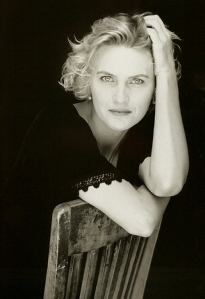
Denise Crosby
Interestingly, the one person we’d all expect to have a comment on CoH’s alleged racist depictions – Denise Crosby  – has been virtually silent on that perceived aspect of the show, focusing instead on her role in the episode and her belief that Tasha Yar was continually being pushed into the background and given more of an “Uhura-like” status.  In her opinion, Natasha Yar was always present but not allowed to change and grow as a character.

Though I find no statements from Michael Dorn (who was not in the episode), Gates McFadden, or the heralded Patrick “Captain Baldy” Stewart, there is universal condemnation for CoH by the near-entire TNG cast!  And almost all of these criticisms fall along the lines of CoH being a racist Star Trek presentment of black Africans, and maybe of blacks globally.  Perhaps, having actually been on the set and worked with both Russ Mayberry, the guest actors, and Gene Roddenberry himself at the time, they know things we may never know?  But such is mere speculation and cannot, at this time, be confirmed.


En Masse, Fans Seem to Agree

Most of the online reviews – whether from younger fans seeing the episode for the first time, fans who grew up with Captain Picard’s Enterprise like myself, or were already mature when TNG came out 25 years ago – are also universal in their condemnation of CoH.  Very few take a positive position, and even fewer take a positive position for anywhere near the reasons The Jainist has articulated above.

In the end, I leave “Code of Honor” for to you to judge. I found it a unique episode because of its demonstration that, in the entire universe, there's at least one group of all-black people out there who are not stone savages, primitive, and backward with respect to their “Caucasian” counterparts in the galactic far reaches.  At least in terms of 20th Century Earth televised SF anyway. And, had the show been executed with a better feel and outlook, I dare say this episode could (and would) have been remembered for that quite overlooked aspect.  Otherwise, from a fiction enthusiast’s point of view, CoH isn’t really particularly memorable!  It's an episode that was well-acted (I dare say) by all involved, but not anywhere on my all-time favs list.

This is my opinion of the episode. What’s yours?


To the upward reach of man.