Wednesday, January 13, 2016

"The Talagxaon Particle, Part 1: Shroud of Shadows": The Reissued Work

It makes my day to let you know that I've re-titled and reissued the Epoc Enuma storyline as The Talagxaon Particle.

I do this for a few reasons:

1) The Talagxaon Particle is easier to pronounce and understand than Epoc Enuma (I bet you had trouble just saying that, huh?) and

2) The new title better expresses the heart and true meaning of the story.

What we deal with in this story is the same theme and element as in the Enuma continuum: the use, and abuse, of great power.


Join me in this exploration, and don't forget to hop over to my new Talagxaon Particle blog!


Star Wars: The Force Awakens: Part 1, An Anticipated Story for a New Generation

Star Wars: The Force Awakens officially opened in the United States December 18, 2015. The anticipation was HIGH for this movie; in fact it was probably the most anticipated movie of the year. And if measured by both weekend turnout and profits from 12/17-20, the movie was runaway successful. Indeed online ticket sales prior to the opening topped $100 million dollars. And current information suggests the movie is well on its way to topping $300 million before Christmas domestically in the United States, and more than $500 million internationally. It was the movie event of 2015, with nearly three generations of viewers waiting on the edge for their chance to be part of a big production.

But was the anticipation worth the wait? Did the product deliver on the hype?

This series of meditations will take a critical look at Star Wars, Episode VII and answer those questions from the Subspace Meditator's point of view.

****WARNING****


From here on out I will be weaving some MAJOR SPOILERS into my critique of this movie. If you haven't yet seen The Force Awakens and don't want to be spoiled, stop reading now. If you don't mind that sort of thing, press forward. But you have been warned!


As stated, I will be weaving plot pointers into my critical review of the story, so do not expect to see a straight-up, linear exposition of what happened from A to B to C. Do not either look to see every detail of the story tied into this analysis. Instead look for what jumped out at me in the big picture with specific events keyed in.

***LAST CHANCE***
SPOILER ZONE AHEAD

NO QUIT? ALRIGHT, HERE WE GO.

The Plot: A New Hope Redux


I'll  candidly admit that I walked out of The Force Awakens both satisfied and unsatisfied, that I was somewhat taken away by the fan comradery and my own desire that this be a fun story I could get along with. And so because of that I came out of the theater giving TFA a reasonably positive rating of 3 stars. Sadly, the more I've reflected on it, that rating must be revised downward south of 3.0 to 2.0-2.5, and that's being magnanimous.
 
R2-D2 & BB-8
The Force Awakens made generous use - if that's the right word - of plot elements from A New Hope and to a lesser degree other aspects of Episodes V-VI. One of the most obvious of these was ANH's use of the droid R2-D2 being sent on a mission by Princess Leia to find the aging Jedi master Obi-Wan Kenobi in order to enlist his aid in delivering the Empire's plans for the very first Death Star to the Rebel Alliance of the era. 

This plot device is practically mirrored by TFA when now-General Leia sends the beach ball-like BB-8 on a mission to find missing Jedi, Luke Skywalker, who has now also ascended to the rank of Master and exiled himself to a remote planet where the very first Jedi temple was built thousands of years ago. Apparently, Skywalker is the key to defeating the First Order, the replacement galactic tyranny risen from the ashes of the old Empire and hellbent on dominating the stars in its shadow. How or why the new First Order has arisen is barely touched upon and is one of a plethora of severe plot holes in the story. 

Starkiller Base, a frozen PLANET-SIZE Death Star THREE!
However, this is not the only plot device borrowed by TFA. Just as in A New Hope - and Return of the Jedi - we are given a new, bigger, planet-sized Death Star called Starkiller Base capable of wiping out not just one planet at a time, but multiple ones simultaneously, and from what appears to be dozens, if not more, lightyears away, all by using the energy of a living star which it syphons off using its big red "eye."

Starkiller Base from the ground, atmosphere and all
Yet, somehow, this WHOPPING superweapon is possessed of virtually the same fatal design flaws and weaknesses of the very first Death Star from ANH and is destroyed in virtually the same fashion! And when it comes time to defend this overpowered big boy from enemy attack there appears to be no starfleet in orbit with any capital ships of merit, nor an adequate fighter defense battalion with the shear numbers to make the difference against the meager Resistance space forces. Consequently, just as in ANH, the Resistance attack squadron is able to fly into what is the heart of this base and, with a handful of X-Wing fighters, cripple it to total abandonment. It is like the First Order learned nothing from its predecessor tyranny about creating or defending what is a key piece of space real estate. Quite frankly this was sloppy, unimaginative, lazy writing of which I blame director and co-script producer J.J. Abrams for, a man who is known for creating mindless, dumbed down action without any real purpose or basis behind it. He did it in Star Trek 2009 and Into Darkness and he's done it again here.

On with the show!

This is not all. On a near point-per-point basis, the plot of The Force Awakens is an almost carbon copy of Episode IV, A New Hope:

* A super spaceship looms menacingly over a planet;
* A robot is sent on a secret mission to find a long-missing Jedi master;
* The robot encounters a lone adventure-seeking youth on a remote desert planet;
* The adventurist youth loses their family on the desert world;
* The adventurist youth runs into a rogue pilot and is whisked away on an epic journey that will alter their destiny forever;
* AND ON AND ON!!

I will not catalog every instance of this asinine ripoff because to do so will tax my patience and yours. But this is what fans have so far doled out millions of dollars for - A New Hope (Again) - hardly worth our time, excitement, and most certainly not our monetary sacrifice. 

Given J.J. Abrams' idiotic Star Trek II: The Wrath of Khan/Into Darkness plagiarism, this mindlessness begs a very serious question: Will Star Wars, Episode VIII be a regurgitation of The Empire Strikes Back too, just with different settings and characters and minor plot adjustments?

But let's get on with what I really want to talk about, the true subject of this post.

The Characters


Specifically I wish to discuss the male characters in this part, leaving the female ones for part two as I have a definitive reason for separating the groups. Let's start with Han Solo.

Han Solo & Chewbacca

Han Solo & Chewbacca repossess the Millennium Falcon
Not much needs be said about either of these two iconic characters' backgrounds prior to TFA; they have both been firmly established by Episodes IV-VI, and by various treatments in the Expanded Universe, etc; everyone knows them by now, very well. What we should be looking at here is how the two characters have changed in the intervening three decades since Return of the Jedi and where that leads The Force Awakens. And the answer, I'm afraid, is not very much. If what we saw on the screen is to be believed, somehow neither the galaxy's most famous bad boy nor his ever loyal sidekick have changed nor advanced much since they helped destroy the Death Star in RotJ, overthrowing the Empire and its ruthlessly tyrannical Emperor Palpatine. Having gone from being a general in the Rebel Alliance, after the dust settles, somewhere between evolving from a smuggler to a war hero, Han Solo returns to us, not as a more mature and seasoned man with thirty plus years experience behind him, but as the same smuggling, conniving, swindler he was before he joined the Rebel Alliance as a liberator of the galaxy, and Chewbacca goes with him! I don't know about the rest of you, but this doesn't sit right with me. How does this happen? Why? No logical exposition for this move is made for what happened between Return of the Jedi and TFA so no emotional attachment nor understanding, beyond nostalgia for the characters, can be invested. There is nothing demonstrable in either of these characters' portrayals and thus nothing bold or risky in them either.

Moving on though. Somewhere between RotJ and TFA, Solo loses the Millennium Falcon only to miraculously find it adrift in space thirty years later after a wayward distress beacon is activated by the fumbling efforts of our new heroes, Finn and Rey. This is one of the most unbelievable, Deus Ex Machina moments of the storyline, inserted to ease Solo and Chewie into the picture! We are supposed to believe that in the vastness of interstellar space, one lone homing beacon goes off long enough and far enough that Solo - who is conveniently close enough - receives and recognized it, and comes running across who knows how many lightyears to reclaim his old ship from whoever or whatever has stolen it from him. Never mind the fact that it's never told how he lost it in the first place. Though, yes, it is nice to see Solo and the "big walking carpet" again, this is all a very lazy and unsophisticated plot resolution.

Further, the reunion between Solo and Princess (now General) Leia Organa is rushed, forced, and awkward. In the one and only brief personal scene between them, we are treated to a minor, but cryptic, exposition as to what separated them and how they've gotten along without one another for thirty years. However, this emotional investment is small, and rather than giving these two super iconic people the screentime they deserve together, we are whisked away with Solo again on a mission to destroy Starkiller Base with Rey and Finn. What is of major significance in the reveal of Solo and Leia, however, is that somewhere between RotJ and TFA, they got married and had at least one kid, Ben Solo - who turns out to be the grandson of Anakin Skywalker (recall that Leia is Luke Skywalker's sister), the nephew and once-Jedi apprentice of Master Luke Skywalker, and the primary antagonist of TFA. And this leads us to our next, and to me, most compelling character of the movie.

Kylo Ren

Kylo Ren, the weakest Sith in history
Easily the most potentially interesting character of The Force Awakens, Ben Solo, aka Kylo Ren, is the powerful Force sensitive bad guy who terrorizes the galactic neighborhood in the name of the Dark Side. Spurred on by his concealed dark master, Supreme Leader Snoke, Ren is the face of the power behind the power, very much as Darth Vader was apprentice and proxy to Palpatine, aka Darth Sidious. In fact it is Darth Vader whom Kylo Ren fancies himself in the shadow of and whom he wishes to emulate. But Kylo is a conflicted being, of himself inexplicably drawn to the Light Side of the Force - and fighting it - but simultaneously trying so very hard to live up to the shadow of a long dead grandfather whom himself renounced the Dark Side at the end of his life. So why is Ren so bent on being a Dark Sider? Is it due to the unyielding influence of Snoke whom himself is also a Dark Side Force master? Or are there different motivations having nothing to do with Snoke?

As compelling as this character first comes across, Kylo Ren, instead of being an intimidating and calculating Dark Sider, soon de-evolves, acting more like a whiny, skulking teenager whose hormones severely unbalance his mental and emotional state. Any strength Ren has in the Force, any skill he wields with a lightsaber, any long-range plans he is to carry out on behalf of his hidden dark master are all eventually drowned out in a wishy-washy emo guy whose trying desperately to get in touch with his feelings. He throws fits when things don't go his way to the point of destroying whole control consoles with his lightsaber in rage-induced cut and slash fests. He miscalculates critical openings in his opponents' weaknesses, leaving himself and the First Order open to obvious gaps in their counterattacks. He is not a mature strategist, Force user, or warrior by any measure. It is clear to see that Kylo Ren, though physically an adult, is a still an adolescent boy whose growth has been stunted by unresolved daddy issues between himself and Han Solo. I think it safe to say that he represents the weakest Sith or Sith-affiliated Dark Sider in the history of the Sith. Indeed, it is my opinion that Darth Maul would have wiped the floor with him, and Darth Sidious would be too humiliated to even speak his name.

Moreover, the actor cast to play Ren, in my opinion, does not at all fit the part. Adam Driver's Ren, sans the helmet, looks more like a teenager pop star idol than a telekinetic sword-fencer bent on intergalactic domination. Mask removed, mechanized voice nixed, and Darth Vader wanna-be killer Kylo instead comes across like someone's little brother throwing a temper tantrum. The power, prestige, and mystique would have been maintained if he'd never taken off the headpiece period. Instead, unlike Darth Vader, who isn't shown for the broken old man he became until Return of the Jedi, we get a premature reveal of Kylo Ren that is bereft of any significant background information that would permit us to give a damn why he's in so much emotional distress and confusion about which path to choose.

And yet with all this weaknut writing, Kylo Ren was probably the most potentially compelling new character of the movie!

Poe Dameron

Resistance X-Wing pilot, Poe Dameron
Poe is probably the most believable character in the story but his screentime is so small that he's underdeveloped and really doesn't matter to the plot much at all. He runs into and out of the movie, possessing, if memory serves, exactly four or five scenes in the entire film. Clearly he's meant to be a hotshot, rogue pilot perhaps in the vein of Wedge Antilles in Episode IV - which itself points again to the derivative nature of this movie - but any emotional attachment we are to have with the character and his ace skills are nixed by the fact that we hardly get to know him. Yes, he smuggles the missing map of Luke Skywalker's location to BB-8. Yes, he leads the attack on Starkiller Base. But so what? We know next to nothing about what motivates him! What is his background? How did he get involved in the Resistance?  These are questions, once answered, that will endear viewers to characters.

I've decided to only briefly review the presence of General Hux, yet another derivative character similar in function and position to Episode IV villain Grand Moff Wilhuff Tarkin, yet inferior in action and performance. The character of Hux left much to be desired as an "Adolf Hitler" photocopy. His speech was shrieking, lacking in both power of delivery and sophistication of content; his mannerisms seemed forced; and his presence as a rival and counterpoint to Kylo Ren ineffective. Hux appeared to be more of a ticked off, privileged frat boy rather than the cool but charismatic and megalomaniacal Tarkin. He was unimpressive in the slightest. And that's all I wish to say of him for now.


Our next discussion on The Force Awakens will center around Finn. And I've chosen to separate this character because my thoughts and insights on him are so long as to warrant a separate section.


Until next time...


To the upward reach of man.

Sunday, January 10, 2016

Star Wars: The Force Awakens: Part 2, The Social Justice Crusade

I had originally planned to make this part two in my series on Star Wars: The Force Awakens. However I’ve decided to not wait until putting the finishing touches on the first part because I believe what’s revealed in the following meditation is central to the message of the new Star Wars. We were brought to theaters with the idea that we were to be engrossed by an entertaining sci-fi story that captured a generation’s imagination and which was set to do so for another. While that was true, there was another agenda. And it is that agenda I wish to reveal now. My original introduction to part two is below. Also, the original posting of this meditation is at my new Talagxaon blog.

**************************


I'm now going to talk to you about why I think this movie had an agenda, and a particular one at that, one that became glaringly obvious as I continued to watch, and which was confirmed in my later researches and readings on the subject. But, first, to set the stage, let's talk about the women who showed up in The Force Awakens, because it is indeed women who are the central focus of my insights into the crusade of this movie.

The Women of The Force Awakens


Princess Leia Organa-Solo

General Leia Organa-Solo
She is the one female holdover from the 1970s-80s trilogy, the feisty Princess Leia, Rebel Alliance leader and battle-hardened but emotionally tender soldier, the lost daughter of Anakin Skywalker and sister of Luke Skywalker, Force sensitive, the love interest of Han Solo. It is Princess, now General Leia who is the most credible female presence in The Force Awakens. In the course of things we learn several important developments about General Organa: she's now a key figure in the new galactic Resistance movement to the remnant Empire-First Order tyranny; she was once married to and is now (presumably) divorced or separated from Han Solo; and together they've had at least one child, Ben Solo, who is also the main antagonist of Episode VII, the ominous Kylo Ren, who desires to be the inadequate successor to his late Dark Side-fallen grandfather, Anakin Skywalker, aka Darth Vader.

But though seeing her again is cool, and though there is a very memorable and emotionally touching reunion between herself and Han Solo, Princess Leia is hardly used to full capacity in the storyline, almost appearing as another backdrop on which to overlay the new feminine mystique of the program, Rey. Though this is disappointing it is understandable from a storytelling point of view. However, many questions remain unanswered about Leia's development in the last thirty years of the timeline, questions I hope are answered as this final trilogy unfolds.

But how does my acceptance of Leia diverge from the others?
 

Captain Phasma

Captain Phasma, First Order military leader
Though we do not know it from the beginning, Captain Phasma is female. And we are only given to realize this when she reprimands renegade Stormtrooper Finn when he's finally starting to question his allegiance to the First Order at the outset of the story. Even Phasma's armor is androgynous in order to prevent the possibility of one discerning she's anything but a competent trooper, presumably male; and she never removes her helmet at any point either. So we only have her voice, which is unmistakably feminine. So be it. However, the criticism of this character is not that she's another girl, but the psychology involved in getting us to accept her on-screen presence, which is based primarily on clever but subtle concealment. From the armor that hides her female body parts to the helmet that cloaks her feminine facial features - and which, once removed, would demonstrate that the gig is up - we are given a character which the scriptwriters seemed afraid might be rejected were it to be shown too soon not to be male. 

OOPs, it's a GIRL! OH, MY GOD!  It's got boobs, it can't be a soldier!

Give me a break. 

Sure, undoubtedly, some audience members - male and female - would have a problem with this. But time and again we've observed the opposite to be true, whether it is in the dedication of fans to characters like Jedi Master and Council member Shaak Ti, Alice of Resident Evil notoriety, or the katana-swinging Michonne of The Walking Dead (my personal favorite character next to Rick Grimes himself!). So what was up with consistently keeping the identity and utility of Captain Phasma secret, as if she would be kicked to the curb and resented if it were revealed she was a woman? The only resentment (and I dare say, rejection) of this persona from most viewers would be that it's another useless creation of a female personality for the sake of creating a female personality, as opposed to one who is compelling and thought-provoking. And that itself has a reason which I will declare at the conclusion of the rest of our Women of TFA profiles.

Maz Kanata

Maz Kanata, the female answer to Jedi grandmaster Yoda
"I am not a Jedi," the short, orange Kanata states to Rey in a critical moment of TFA. But clearly she is a mystic of some report who is not only specially attuned to the Force, but is also mysteriously in possession of Anakin Skywalker's lightsaber, the same one given to Luke Skywalker by Obi-Wan Kenobi, and lost during Luke's duel with Darth Vader in Cloud City. It is Kanata who senses the lightsaber's call to Rey in the underground passages of her Mos Eisley-style bar and who informs Rey of her own affinity in the Force. Clearly, though she is not a Jedi, Maz Kanata is meant to be the wizened elder who reveals to Rey, however temporarily, a greater sense of her destiny to come, she who initially sets Rey's feet upon the esoteric path. She is the female equivalent to Jedi grandmaster Yoda (who similarly reveals to Luke Skywalker his own unfolding Jedi destiny) though Kanata herself has never trained to be a Jedi nor lightsaber combatant. To be clear, nothing in Star Wars lore mandates a Force user to be a Jedi. It is simply that these particular Force sensitives have always been front and center of its application in the Star Wars universe.

But is Maz Kanata's presence simply another bow to the fangirls of the series, another way to tell the female audience members, "Look, Star Wars is for you too"? With the plethora of women who repeatedly appear in TFA it can be argued just so, especially as two more, female spies - one for the First Order and the other for the Resistance - show up in Kanata's bar just as our heroes do.

On the right, one of two female spies featured in Kanata's pub
But, "What are you saying? Chicks can't be spies?" Sure they can! And history proves they can be very effective ones when trained properly. The observation here centers around the shear number of women we continue to see in the storyline and asks the reader to ponder why. 

Rey

Rey, the girl who can do anything...and better than any man
This is the desert scavenger who is the central focus of our story- though we are initially misled to believe otherwise. In fact, much of the run-up advertising and even the start of the movie itself misdirects the viewer to think that it is the character Finn who is not only the key figure in this new Episode VII, but also the one in whom, eventually, the Force will awaken. This turns out to be false advertising, and may in fact have been part of the kinds of misdirections which J.J. Abrams is famous for.

However, what we are treated to with the character of Rey is a young woman who is at odds with the universe around her, isolated, and somewhat maladjusted. Fine. Very good. Character traits we can get along with and which are interesting for plot development. Unfortunately, these things, which stand to be the "meat and potatoes" of the character, are only given marginal screen-time, and hardly explored. Instead what we are offered is how smart and tough Rey is. OK! Still fine character traits, but unbalanced with the others in favor of showing us just how strong, modern, and independent she is. Rey becomes, not a character in whom viewers can invest emotional attachment, and whom they may possibly be able to identify with, whatever their sex, but a caricature for the modern feminist woman who ballyhoos at every opportunity, "I don't need no man!" 

Combine these things with the fact that Rey can do anything from fix broken hyperdrive coils to piloting speeders and antique spaceships, to doing in the Force in days what it took more powerful Force adepts than she years to learn, including Chosen One Anakin Skywalker - a veritable genius Rey is! - and you have the perfect recipe for every sci-fi chickadee's dream, a girlie girl who can run circles around the boys while gleefully singing, "Anything you can do I can do better. I can do anything better than you!" And all while keeping her clothes completely on at that!

Social Justice Warriors, rejoice! You now have the sci-fi feminist icon you've waited forty years for!

TFA as a Social Justice Experiment  


Enterprise bridge officer Lt. Uhura, Star Trek: TOS, 1960s era

This is not to say that there's some kind of problem with intelligent, capable females. Indeed in Star Wars as in Star Trek and other sci-fi incarnations, there have been plenty of such type women - from female Jedi and Sith warriors like Ahsoka Tano, Luminara Unduli, Depa Billaba, and Asajj Ventress to women Starfleet officers like Kathryn Janeway, Jadzia Dax, and Kira Nerys; but knowledge of at least some of these awesome SF girls requires a slightly deeper effort to know than mere passive ingestion of television and films. They also require that we refuse SJW efforts to cast these ladies down a convenient memory hole in order to make a point when SJWs don't have one. Given such examples (and there are plenty more) is it then credible that feminist SJWs harp and cry that there are no authentic female sci-fi heroines they can relate to?

Or is it more credible to think that what many feminist SJWs, and their progressivist male allies, are really hollering for in science fiction is the presence of more white female leads and the unqualified worship/acceptance of such leads by men?

That stated, the notion that this observation is about denying chicks their "grrl power" in science fiction is absurd and should not be asserted by anyone objectively reading this criticism. However, we must ask why in TFA was there a consistent, ever-recurring theme to bombard and bamboozle the audience with image upon image of women in positions of authority and/or power, and, in the case of the character Rey, why this very underdeveloped personality was shown in scene after scene either outclassing or upstaging her male counterparts, including in areas where their own expertise was imminently greater than hers. Examples of this include her telling Han Solo how to fix a critical malfunction aboard the Millennium Falcon, a ship he was intimately familiar with before the gifted Ms. Rey was even born, and which she'd only just stepped foot on hours prior to his arrival; her rescuing Finn from the First Order assault on Jakku, and subsequently from the monsters aboard the Falcon; and saving Finn from death at the hands of Kylo Ren on Starkiller Base by besting the wanna-be Darth Vader 2 in a lightsaber fight.

And that example itself raises criticism. Any observing, thinking viewer has to wonder how in bloody hell does an untrained duelist, barely Force-conscious individual like Rey go from having no conceptualization of her own power in the Force to being able to suddenly, expertly "tap into" its living essence - essentially in a matter of days - so much so that she's able to Force Will a stormtrooper to release her from captivity on Starkiller Base and, later, to fight Kylo Ren - a trained and skilled Force wielder and lightsaber duelist - to a standstill though she had not prior experience nor training with either.

Clearly, and without objection, Rey is a talented being, one whose natural ability (particularly with the Force) can be likened to an individual with an "ear" for music, but who has yet to learn how to read music or control his/her own voice. She has raw, undeveloped talent which explodes onto the scene without explanation or cultivation. But she has no skill. And at some point her loosely-awakened, innate talent begins to stretch the boundaries of credulity.

But Why Repeat These Elements Ad Nauseum?


Star Wars was always a boys’ thing, and a movie that dads could take their sons to. 
And although that is still very much the case, I was really hoping this could be a movie 
that mothers could take their daughters to as well.

-- JJ Abrams

The answer, I claim, to not only the "girls are awesome" trope that runs through TFA, but also to Rey's overcompensatory coolness, can be found in the statements of both Lucasfilm CEO Kathleen Kennedy and Episode VII director J.J. Abrams, each of which has candidly asserted their desire to use The Force Awakens as a vehicle to promote the empowerment of girls and women in science fiction and the real world at large. And there is nothing wrong with this idea in principle; if women wish equal rights and privileges in society, that of course will entail full-fledged access to equal opportunity, with the accompanying equal responsibility and accountability to boot.

Linda Hamilton as Sarah Conner from The Terminator series
However, time and again social justice warriors, particularly of the white female feminist variety, attempt to convince us that images of strong, competent women in the media of science fiction (such as the 1960s Star Trek Lt. Uhura shown above) simply either do not exist or are so few and far between as to be inconsequential and unimportant, especially to the inspiration and imagination of girls and women. And thus, in order to compensate for this alleged inadequacy, we must be utterly overwhelmed in modern-day entertainment with this imagination-becomes-reality scenario: fiery but dignified women who can fight stronger and better trained men to the ground (or at the least, to a draw); sharp, intelligent chicks whose technological wizardry runs circles around their male counterparts; or, on the other side of things, cynical and potty-mouthed women whose sardony and sexual liberation puts even a drunken sailor's lifestyle to shame.

Sigourney Weaver as Ripley in Alien
But this perceived lack of "strong women in sci-fi" is not true, and further has not been for decades. I will not catalog every incarnation of tough, diligent female leaders in science fiction and fantasy over the last forty-fifty years, whether in film or print media, because to do so would require several pages. Suffice it to say the information is out there, and just doing a cursory search on the Internet will prove this case. So, again, the notion that there is some perceived lack of female role models for young girls and women to aspire to emulate in SF is just that - a perception - and an incorrect one at that, and one which continues to be demonstrably more untrue as the examples multiply in the fiction stories of the current era.

So, Ms. Kennedy, Mr. Abrams, was it so absolutely necessary to hound us with something that most intelligent SF adherents already know and which most of us have no objection to seeing? I argue not, and further that it would have been better for you to concentrate primarily on giving us a superior story that smoothly incorporated compelling female identities rather than a movie through which you wished to cram down our throats your Star Wars SJW experiment.

The Feminist Force Awakens


I don’t have many choices. But that’s going to change. Going forward with all 
we’re talking about there are going to be a lot of wonderful new [female] characters.

-- Kathleen Kennedy at Star Wars Celebration, 2015


The venomous Diana from the 1980s sci-fi hit, V
At the risk of redundancy, my objection to the profusion of women in The Force Awakens is not because they are women, but the function of these women as a tool of propaganda and brainwashing. It now appears that Star Wars will become a tool of political correctness and 21st century women’s suffrage rather than the grand operatic space adventure it was always meant to be. Women will not be incorporated into these stories because they are fascinating people with remarkable backgrounds to be explored. They will not add to the great themes of science fiction which examines the human condition and makes insightful commentary on that condition through the guise of futuristic, far-away space adventure. Their skills as fighters, leaders, or savvy scientists will not be earned nor developed but handed to them simply because… well because they’re women. It is an absurd proposition that we are asked to accept this stupidity, and even more absurd that an iconic series like Star Wars has been corrupted, sacrificed on the altar of political correctness, female insecurities, and feminist lunacy.

Kathleen Kennedy and J.J. Abrams saturated TFA with women because their agenda to see women front and center of the sci-fi phenomenon was greater than their desire to tell a genuine, original story that paid homage to this giant of speculative fiction entertainment. Their aim to feminize Star Wars on behalf of a social justice crusade should not be accepted by those who’ve come to love it and its message of liberty, justice, and epic excitement.

Cmdr. Susan Ivanova, 1990s sci-fi adventure, Babylon 5
Further, there was utterly no need for this kind of brainwashing for, as stated earlier, the examples of the types of sci-fi women Kennedy and Abrams would have us believe do not exist have in fact existed for years and decades, and in plenty quantity. They have been heroines, villains, geniuses, morons, saints, whores, and everything in between. In other words they’ve been human characters with the requisite flaws, nuances, and ambitions necessary to create personalities of depth whom audiences could love and hate. Therefore the idea, as Kathleen Kennedy seems to erroneously believe, that there are few women in science fiction she and other female humans can identify with is ridiculous and unfounded on its face. It is a foolish perception that should no longer be accepted by those with knowledge of science fiction history and enough memory to count, or for those with just some basic research skills.


In my next post on The Force Awakens I will delve into the other principal characters and what I thought of them and their relationships to the overall arch.


Until next time...


To the upward reach of man.

Tuesday, September 29, 2015

Enuma... Genesis... Talagxaon? What's Up?

By now followers of this blog and the renamed Talagxaon Particle blogspot are no doubt seeing these alterations to the story's title. Yeah.

So what's up with the name changes?

They are the travails of a writer I suppose.

Admittedly, from the beginning, I've struggled to find the right description that hones in best on what I'm expressing with this saga. When I first envisioned the Particle concept some nine years ago, at first it was about a new beginning. And it still is. But as I continued I realized that the "new beginning" talked about in the line -- "New  Evolution. New Age. New Genesis. New Enlightenment." -- all that hinged on something fundamental, something elemental. Epoc Enuma, my deliberate misspelling of the word "epoch" and transliteration of the Babylonian word "enuma" to collectively mean "New Genesis," wasn't good enough. It wasn't specific enough. Besides, most of you couldn't pronounce it right anyway and didn't know what it meant either!

Thus The Genesis Particle was born. But that wasn't enough either because, you see, GENESIS wasn't the full expression of this concept itself! It got closer, but not quite.

I kept searching, and blimey, finally found what I was looking for when I thought about the real underlying, and underlining point of this whole story! Everything together now, and what do I see? - a transitional particle so at the heart of things, so unique, and so powerful that it brings everything together.

Folks, what I'm talking about here is the basis for creation itself and the basis for transversing creation!

THIS is the real meaning of my story, and so the real title had finally emerged. I only needed a word that powerfully and poignantly stated what I wanted. I searched, and searched, until, at last, it came to me. And so here it is:

THE TALAGXAON PARTICLE


This is the cause for which everyone in our epic will race whether they know it or not, and for which I finally, ultimately, at last, have a title that expresses my heartfelt realization! What does "talagxaon" mean? Keep reading and find out.

As we go deeper into this tale you'll start to see pieces fit together that at first appeared incongruent. You'll start to understand why the immediate focus wasn't on the talagxaon itself, why it's kept a mystery from everyone. You'll begin to more fully realize why we discuss the upward reach of man at this and the Talagxaon blog, and how that philosophy ties into the Talagxaon storyline.

So, welcome aboard...again. And get ready for the journey. This is not a one-off.


To the upward reach of man.

Wednesday, September 23, 2015

The Leadership Principle: Starfleet's Finest in the Captain's Chair, Part 2

In our last blog we discussed the leadership styles of Captains Kirk, Picard, Sisko, and Janeway and how each of them expressed their unique command abilities with respect to the starships they served. Let us now turn our attention to how each of these captains were a representation of the real-world times in which they were portrayed on the small, and in some cases, on the big screen.

Captain Kirk: The Fighter, the Hero, the Aggressive Commander


James Tiberius Kirk
These four captains' styles of command are as individual as they are, and, the Meditator believes, are all representative of the times in which they led their respective starship crews. Of all that we may contrast distinctly due to the era in which he commanded, Captain Kirk must stand alone for several key reasons. Captain Kirk's Enterprise represented a Starfleet in which the galaxy was less explored, human technology less developed, and, in my opinion, certain rules of Starfleet and starship culture were less strictly defined and enforced. Also, in Kirk's time the Klingons were avowed enemies, as were the Romulans. In other words, James Kirk lived in a Starfleet more aggressive than that of our other captains.

Consider: In 1960s America we were aggressively dealing with the Soviet Union and International Communism; race issues domestically, including riots and the Civil Rights movement; anti-war movements, such as that against Vietnam; and counter-cultural reactionism against the Establishment (Hippie "Flower Power" and "Free Love" are examples of that). All of these subjects were tackled in one way or another by the original series.

Yet even through these seemingly insurmountable problems, the America of the 60s represented a nation more confident of itself and its values than of today. It was a country more firmly centered in classical ideas of Western Civilization as they were then understood, and thus it was a nation that stood firm in its outlook, even when faced with external and internal turmoil. The Meditator affirms that such outlook was reflected in the 1960s Star Trek and personified specifically in the person of Captain James T. Kirk.

None of this is to say that James T. Kirk was a hyper-aggressive brute out to shed blood and start conflict any chance he got, but to illustrate how the personality of this superbly dynamic Starfleet officer reflected both his fictional and actual world environment.

The 24th Century Commanders: Thoughtful, Diplomatic, & Dynamic


Jean-Luc Picard
By contrast, the Starfleet of Picard, Sisko, and Janeway is a much more settled institution, with rules and regulations befitting that of a more organized and mature space exploration agency. Thus, in your writer's opinion, we see a far less cavalier and grittier Starfleet than we do in Kirk's time, at least on the surface.

Comparatively, the three 24th Century captains themselves were dramatized during less turbulent times in both the life of the American nation and that of the world as a whole. While Picard is perhaps the most cerebral and intellectual captain to date - possibly only being surpassed in that mantle by Janeway due to her scientific background - he nonetheless represents a calmer, more thoughtful, less aggressive Starfleet as a whole. Picard is emblematic of a Starfleet that is at overall peace with the known galaxy, and offers a more diplomatic perspective on the application of force than does Kirk.

Ben Sisko
In the real world, the Treks of TNG, DS9, and Voyager represented an America financially prosperous, internationally stable, and more or less socially cohesive on the homefront.

As an example let's briefly think about the first Gulf War which occurred during TNG's run in 1991. Here was a conflict that ultimately set the stage for the toppling of the Iraqi regime of Saddam Hussein in 2003. Yet, as historically notable as it was, Gulf War I paled in comparison to the monumental and world-altering 9/11/01. Indeed, 9/11 had not yet occurred even while Voyager was still on the air; in fact, Voyager had completed its seven-year run by the time September 11th happened. The last series to date, Star Trek: Enterprise, had the distinction of being on-air when the attacks took place, and of dealing with the event in a fictional counter-portrayal.

Even during the time of Ben Sisko and DS9, the Dominion War was not a representation of any real-world conflict of note, but a fictional portrayal of the ongoing expansion of influence of the human Starfleet and its interaction with the Bajoran and Changeling peoples. And though we might claim that out of all the 24th Century captains, Sisko was certainly the most passionate and dynamic, even this Starfleet officer tempered, and was tempered by, his environment and circumstances. In this regard, I've given considerable space to why I believe Sisko perhaps the most well-rounded character of the new captains. Please feel free to review it.


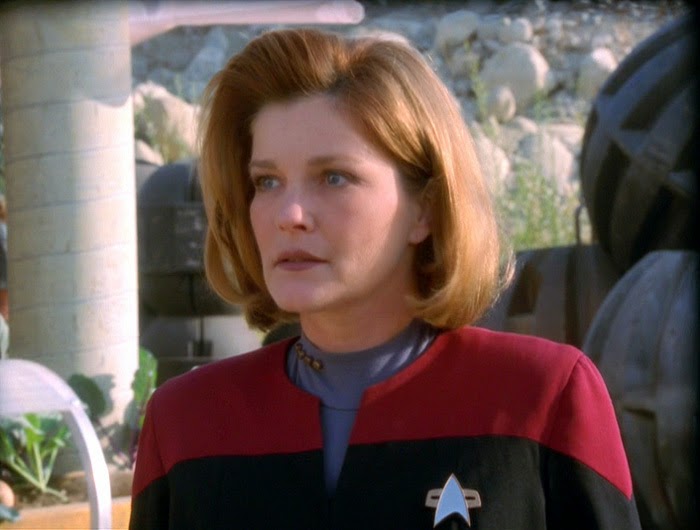
Kathryn Janeway
It is also worth noting that during the Janeway years, Voyager's encounters with the Borg Collective did not represent any major true-to-life events, but, once again, the continuation (and furtherance) of a conflict began with the introduction of the Collective in the TNG episode "Q-Who." The journeys of Captain Janeway and her crew to get back to the Alpha Quadrant were certainly interlaced with danger and hardship, yes, but represented the on-screen excitement of pure adventure and the exploration of space which Starfleet was created to advance. Does any of this mean that Janeway stood out less than Captain Kirk?

Does it mean that any of the 24th Century captains stood out less than Kirk because they occupied times that were less dynamic in their fictional portrayal of reality? The Meditator thinks not. Any and all of the 24th Century starship leaders proved beyond doubt that they were more than capable of holding their own and giving back as good as they got in all areas of starship command life. They proved that the Starfleet of their time was no less courageous, no less human than that of Kirk's. Indeed, Starfleet, like its captains on the bridges of their majestic vessels, had become more sophisticated and savvy about the universe and the wonders within.


This is the Captain Speaking...


Kirk, Picard, Sisko, & Janeway
The four Starfleet officers we've studied here represent profiles in character, courage, understanding, and leadership on multiple levels. And, in your writer's opinion, they show that the Treks of the late 80s through the early 2000s were quite in contrast to the societal upheaval taking place in the American 1960s or the economic and international uncertainty of today. The more aggressive and passionate Captain Kirk, and his Starfleet, was a reflection of the American times in which he was created. And so was Picard, Sisko, and Janeway, but from obviously different perspectives. Your writer reiterates that these captains' attitudes were a reflection of the real-world times in which they were portrayed.

What will the next Star Trek captain be like? One cannot say specifically, but if Trek tradition continues to hold sway, he or she will almost certainly be a mirror for the American and planetary condition of their time.


Until next time...


To the upward reach of man.


*******************

For those wondering: Why no analysis of Jonathan Archer and the crew of Star Trek: Enterprise? As before, when I first began this meditation, I explained in part one that I rarely watched this series when it was on broadcast TV (and still have not to this day) and thus cannot be as easily insightful with it as I can with the other Star Treks. Perhaps I will actually sit down and watch Enterprise from beginning to end one day and do for it what's been done in this group of meditations. We'll see.

Thursday, December 4, 2014

Another Shining Star of Black African Brilliance: Meet Apex Mind Boffin Ramarni Wilfred!

Originally posted at The Genesis Particle blogspot, here's a repost of a fantastic discovery!

**********************************************

Here at The Genesis Particle Blogspot HQ, I believe in spotlighting rays of hope and brilliance in the human future, and, as a Black American, those shining stars of Black brilliance who are participating in uplifting the Black African Diasporatic presence in that future.

With the discovery of Boffin Ramarni Wilfred, another example of Black people's exemplary capabilities has been found! This young fellow has an IQ superior to Einstein, Stephen Hawking, and Bill Gates! His individual potential is remarkable, and his example to human potential spectacular.

Let's wish this youngster great success as he journeys the path of the giants whose shoulders we one day hope he will stand on as a fellow astrophysicist and natural philosopher!

From the Atlanta Black Star online, a feature on Ramarni.

Could you beat Einstein or Stephen Hawking in a pub quiz? Probably not, but one 11-year-old boy could probably give them a run for their money.

Boffin Ramarni Wilfred,  boy genius
Ramarni Wilfred, of Loom Grove, Romford, England, took a Mensa test and has been told he has a higher IQ level than Steven Hawking, Bill Gates and even Albert Einstein.

He said: “I can’t begin to compare myself to these great men whose hard work clearly proves that they are true geniuses.

“Who knows? Perhaps my ‘true genius’ moment will come when I grow up, but for now I am just proud of myself and happy that my mum and sister are proud of me too.”

Ramarni, his mother and older sister moved to Romford two years ago, but it was a lot earlier that his mother Anthea started to realize there was something a little special about her son.

Anthea, 37, said: “By the time he was 3 he could read and writ,e and from 18 months we discussed the news and his favorite book was an encyclopedia.”

Ramarni was part of the gifted and talented program, a scheme to develop the abilities of more able pupils, as well as the Brilliant Club, a program for those aged 10-16 who come from less privileged backgrounds, held at St Anthony’s Primary School, in Upton Avenue, Forest Gate.

After being invited to a graduation ceremony at Oxford University after writing an essay awarded a 2:1, he was then invited to take an IQ test at Birbeck University.

But it was to his surprise, he was given an IQ of 162, placing him in the top 1 percent in the U.K. Ramarni said: “I was surprised and very happy when I read the results of my IQ test as I didn’t feel very confident ­after completing the test.

“I was the youngest person there and some people looked in their 40s.”

Mensa’s chief executive, John Stevenage, said: “Ramarni’s score shows he has great potential and we are pleased to welcome him to Mensa.

“We hope he will enjoy being part of the society and interacting with fellow members.”
 
As a member, Ramarni will now be invited to exclusive events and will be able to mix with people of his own age with the same interests as himself.

He added: “I don’t really see having a high IQ as a big deal, but I do feel very privileged to be invited to join Mensa and can’t wait to ­attend some of the events.”


The Subspace Meditator says: Go forth, kid! Take us to the stars!


Until next time...


To the upward reach of man.

Monday, December 30, 2013

The "Pretender" Phenomenon & Human Potential, Part 1

There are Pretenders among us.

Geniuses with the ability to become anyone they want to be.

In 1963, a corporation known as the Centre isolated a
young Pretender named Jarod and exploited his genius
for their research.

Then one day, their Pretender ran away...


From 1996-2000, these were the opening theme words for the belated NBC tv series The Pretender. This TV program chronicled the exploits of a genius named Jarod who was taken from his parents as a child. Over the course of four years, the adult Jarod remembered and sought answers to who he was and where he came from. Simultaneously, the viewing audience was granted a unique look inside the world of a storied mastermind who could assume any identity, any personality, any skill set he chose within a matter of hours or days. Literally! From doctor to race car driver to insurance salesman to astronaut, Jarod used his innate gifts honed at the Centre to defend the weak and defenseless, and to empower the powerless.

For one hour every Friday, Jarod so completely became a fake personality that he was able to convince everyone from a restaurant cook to an FBI section chief that he was who he claimed to be. His talent represented a kind of total immersion into the new identity's world and environment, a total immersion that has been thought on by psychologists and others who are pushing the boundaries of what we know about the human brain and its capability.

In other words, though actor Michael T. Weiss' Pretender may have been nothing more than a fantastic character, there is science behind the fiction. Further, there may in truth have been (or be) factual personalities behind the imaginary one. And it is these investigations, and those real personas, and what they all together could mean for further unlocking human potential, which is the subject of this meditation.


The Fictional Pretender and His Equals

Let's begin with a profile of The Pretender program's fictional representations of this extraordinary talent.

Profile 1: Jarod

Life's a gift.

-- Jarod

Jarod
As stated, Jarod is the series hero and its primary focus. His abilities as a true, natural Pretender are portrayed over and over and consist of two distinct but very different aspects. The first is broken down into two parts. Part A of aspect one is Jarod's unique ability to eidetically remember every detail he's exposed to. This, in effect, refers to Jarod's capability to photographically recall places, events, sounds, smells, etc, with near-total recollection as he chooses them necessary to complete his task. Part B of the first aspect is Jarod's fantastic working memory, which refers to his ability to hold multiple transitory (or temporary) pieces of information in his mind for later manipulation and use.

The second aspect is Jarod's ability to mimic the skill sets and personality types of any kind of profession or work environment he chooses to infiltrate. As in our introduction, this gives Jarod the ability to act and talk (and most importantly to assume the skills and mentality of) a doctor, engineer, teacher, lawyer, mobster, race car driver, professional chef, FBI agent, etc. He's even become an astronaut! And all of these skills are assumed without Jarod setting foot in a classroom or learning from a professor. Jarod learns the skills he requires to accomplish a "pretend" through a process of total immersion into his target environment by setting up what the series calls "simulations." In the TV program, a simulation is a recreation (whether whole or partial) of an environment into which a Pretender wishes to submerge himself. Jarod often used such simulations to teach himself what he needed to know about a place or situation in which he'd never been before so as to prepare himself for the numerous possibilities that would eventually arise from his interaction within said situation. Additionally, it was clear from the TV series that Jarod used his simulations to prepare for what could not be prepared for - that is, those unanticipated variables that arise as a result of the human equation in any circumstance. Though it was rare, Jarod did encounter what the Meditator calls sub-situations of the main situation for which he was not ready. And it was at such times that Jarod's ability to "pretend" was most effectively seen, for this amounted to his ability to think on his feet, rather than merely pre-anticipating and pre-planning for every event. These scenarios were most often observed when, at the end of most episodes, Jarod had to escape, unrehearsed, from the relentless pursuit of his main nemesis, Miss Parker.

As we come to learn, these functions of Jarod's brain are governed by a unique genetic sequence which allows him to access such amazing capabilities and naturally become the kind of person he is. Fundamentally, then, genetics (conjoined with training and certain psychological manipulative techniques) are also the basis for much of the other Pretenders' capabilities we see over the course of the TV program.

Jarod, as a character, is unique in other ways too. During his time outside The Centre we come to learn that, as a result of his deprived childhood, Jarod is deficient in certain fundamental "growing up" experiences. He's never eaten cotton candy, had a stick of chewing gum. He's never gone to a carnival, played with coloring books, or for that matter had a toy set. Through these experiences and so many more, the viewer comes to learn that Jarod's innocence and naivete is the rationale for his actions. And from these the viewer gets, in a way, to recreate his or her own childhood through Jarod's eyes. And this makes Jarod both a sympathetic  and empathetic character, not only to children, but to others who are not as strong and resilient as he. Further, they highlight Jarod's desire to defend the weak and abused as being motivated by his time at The Centre where he learned that the simulations he performed as a child were often used to bring harm and suffering to innocent people. Once he escaped captivity his every pretend was to "make amends" by using his great ability to balance the scales of justice for those who could not find it on their own, and to bring justice to those who deemed themselves so powerful or so cunning as to be above it. Moreover, Jarod's strong sense of morality, despite all efforts to relieve him of it at The Centre, make within him a courageous personality who does not succumb to using negative means to gain his ends. In each of his pretends, Jarod always takes the high ground of action, never disobeying or breaking the law, even to bring others under the heel of its justice or to win it for those whom he has decided to help.

Profile 2: Kyle, the sociopathic Pretender


I decide who lives or dies.
-- the childhood Kyle in a session with Mr. Raines


Shockingly, we come to learn that Kyle is Jarod's younger brother also kidnapped by The Centre when they were just children. Raised separately at the facility, Kyle's training takes a very divergent path from that of his brother. Abused and tortured by the deranged psychologist, Mr. Raines, Kyle is trained to use his Pretender talent for selfish, manipulative, and destructive ends. When we first meet Kyle, we learn that he has escaped from a maximum security prison and even while inside was using his ability of mimickry to "talk like a doctor, a lawyer," and even to get a prison guard a sizable amount of money on his tax return. Ultimately, however, Kyle is trying to find those responsible for his kidnapping and imprisonment at The Centre, and to punish those he believes responsible for his mistreatment while there. This leads Kyle to finding Jarod after the latter discovers him free and on the loose in the real world working as an assassin.

As a Pretender what is interesting about Kyle is in fact his sociopathic indoctrination by Mr. Raines. Kyle's abilities to pretend are quite similar to Jarod's. In fact, it could be argued that there is qualitatively very little (if any) difference in their overall talent. However, as a pupil/subject of Mr. Raines, Kyle is trained to leave behind all traces of morality and empathy and to exercise his talents to pretend with complete and cold objectivity. The series demonstrates this in flashbacks to Jarod and Kyle's time at The Centre when both young Pretenders are using their skills in various assorted joint simulations. Kyle chooses to ignore the moral implications of the simulations while Jarod chooses to incorporate, or at least raise the moral angles. The choice to ignore the moral angles makes Kyle a much more dangerous target because - unlike Jarod, who chooses not to exercise his great mental gifts to harm others - Kyle has no compulsion against destroying that which he deems unworthy of his sympathy. If he had remained alive and free, it seems quite clear that he could have indeed taken a very serious fight to The Centre and those whom he believed personally responsible for his torment while there. The unfortunate loss, however, of Kyle was a heart-wrenching blow to Jarod - who was in a constant search for clues and ties to his past - and, the Meditator believes, a blow to the series in that Kyle as a Pretender, especially one without moral and ethical boundaries, would have made a great counterbalance to Jarod in his quest to bring justice to The Centre, its creators and allies.


Profile 3: "The Chameleon" Pretender, Alex

We are introduced to Alex in the made-for-TV movie, "The Pretender, 2001." This is the third Pretender program in which a gifted personality other than Jarod and Kyle is portrayed. However, unlike Jarod, the Pretender whom we come to know only as Alex is another sociopath with a vendetta against The Centre and society as a whole. Unlike Jarod - who is trained as a child by Sydney - and Kyle - who is trained as a child by Mr. Raines - we do not know if Alex was kidnapped and imprisoned by The Centre as a boy nor by whom he was instructed while there. We do know that Alex attempted to escape The Centre with Jarod and a fourth Pretender named Edward many years later in adulthood. Alex's escaped failed and he was recaptured and thereafter tortured and then assigned to an organization called the Triumvirate, a superior group to The Centre with whom the latter has intricate ties. Alex first comes to Jarod's attention when a series of taunting messages arrives from a villain identifying himself only as the Chameleon. Within these messages are coded statements ultimately revealing the Chameleon's true identity. Of course, the Chameleon's purpose is for only Jarod to understand their real meaning: revenge for what he believes was his abandonment at The Centre during their escape attempt many years prior. However, simultaneously, a string of odd murders also occur that leave behind clues which lead Jarod to suspect that the Chameleon exhibits superior adaptive skills which suggest Pretender traits. He goes on the hunt for the Chameleon disguised as an FBI agent. However, the Chameleon fights back, attempting to frame Jarod by using his own Pretender skills as the bait and switch. Ultimately Jarod finds and confronts Alex as the Chameleon, but not before Alex manages to kill their fellow Pretender, Eddie Ballinger. The startling factor in Jarod's pursuit of Alex is not his chase and cornering of Alex, but in the revelation Alex makes at Jarod's almost successful apprehension just prior to Alex's "suicide" at a water plant. He tells Jarod that The Centre has not been chasing him all over the country just because he's their prize Pretender; it's much deeper than that. Further, Alex tells Jarod that he will not give him the answers. If Jarod really wants to know the answers to all the secrets then Mr. Parker is the one to seek out. Alex then falls to his "death" in a watery grave dozens of feet below. But his body is never recovered, leaving the viewer to wonder whether - in true Pretender fashion - if Alex actually escaped alive.

Profile 4: The sub-Pretender, Eddie Ballinger


From what we know, the Pretender named Edward (Eddie) was taken from his parents, just as Jarod, when he was a small boy. However, according to Mr. Raines, Eddie, unlike Jarod, Kyle, or Alex, was not a natural Pretender. He was a "sub-Pretender" who was trained in the Pretender talent, but possessing obvious gaps and flaws in his abilities to pretend. This made Eddie less important to the work of The Centre, and when he escaped, the corporation did not pursue his recapture as it did that of Jarod, Alex, and Kyle. Eddie went on to make a life for himself as an NSA agent and family man, free to interact with society as he chose. He continued this life until his untimely reunion with Jarod years later, which ultimately led to his death at the hands of fellow Pretender, "The Chameleon," Alex.


Profile 5: the savant, Angelo


Angelo is not a Pretender, but a supernormal empath, created by Mr. Raines, who is capable of "absorbing" other individuals' personalities and feelings. Angelo was Mr. Raines' failed attempt to artificially create a Pretender from a subject lacking the natural talent to become one. Angelo's subsequent creation as a savant empath, however, was accomplished by first breaking down his real personality via electroshock treatment and drugs and then by "rebirthing" a new personality in the shredded mind of the old one. This combination of torture and drug abuse on the part of Raines somehow brought to life a personality within Angelo that allows him to literally absorb the emotional state of mind of an individual simply by looking at a possession of the target subject- such as something they wrote, drew, or even a long-held personal possession, like a watch. Angelo has used this ability to help The Centre track Jarod's location several times, but also, unknown to Centre personnel, has used his talent to secretly assist Jarod in eluding Centre capture by misleading them.


Now that we've covered some of the special personalities that made up the fiction of The Pretender series, in our next look at this unique program, we shall turn our attention to the science behind the fiction in an effort to understand whether there is actually any reality to the show itself.

I believe the answers we find will indeed amaze us.


Until next time...


To the upward reach of man.